

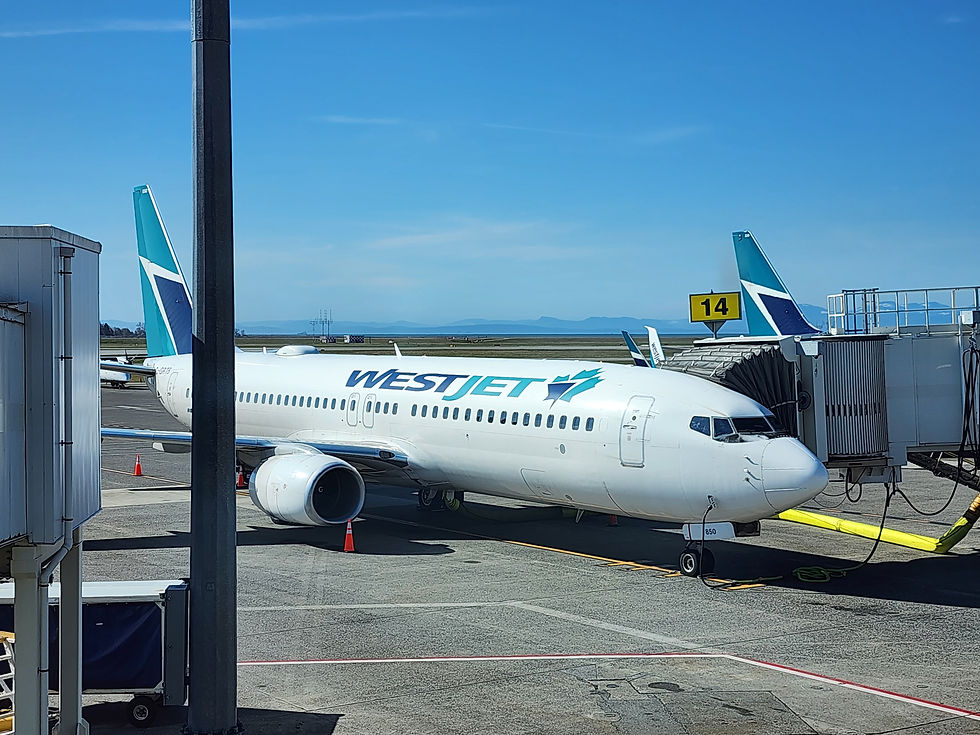
Airline Chronological History
WestJet is headquartered in Calgary, Canada. It was founded on the 27 June 1994. It was the third largest airline in Canada, behind Canadian Airlines International Inc. and Air Canada. It began operations in 1996 with 220 employees, three aircraft, and five destinations. It was launched as a low-cost alternative to the country's major airlines.
WestJet officially began service on February 29, 1996, launching operations with three Boeing 737-200 aircraft serving only five cities: Calgary, Edmonton, Vancouver, Kelowna, and Winnipeg. From the beginning, the carrier emphasized a single-type fleet strategy, point-to-point routing, and an upbeat corporate culture that would soon become central to its brand identity.

West Jet started operations in 1996 with Boeing 737-200 serving only five cities: Calgary, Edmonton, Vancouver, Kelowna, and Winnipeg. (Photo: Planetspotters.net) A key early milestone occurred in 1996, when WestJet transported its first 100,000 passengers, demonstrating strong demand for low-fare travel across Western Canada. By 1997, the airline expanded to include cities such as Regina, Saskatoon, and Victoria, strengthening its presence in the region. Its early success led to rapid fleet growth, and by 1999, WestJet operated 10 Boeing 737 aircraft—double the number planned in its original business model.
The 2000s marked a transformative decade as WestJet evolved from a regional low-cost carrier into a major national and international airline. In July 1999, WestJet launched its initial public offering (IPO), raising capital for expansion. This allowed the airline to begin its ambitious growth into Eastern Canada. By 2000, WestJet added Hamilton, Moncton, and Ottawa, and by 2001, service reached Toronto and St. John’s, creating a truly nationwide network.
WestJet continued renewing and growing its fleet. The early 2000s saw the introduction of the Boeing 737 Next Generation series (737-600, 737-700, and 737-800). The first 737-700 joined the fleet in December 2000, offering greater range and fuel efficiency.

The first 737-700 joined the fleet in December 2000. (Photo: Airfleets.net) International expansion began in 2004, as the airline launched flights to the United States, including Los Angeles, San Francisco, Phoenix, and Las Vegas. By 2007, WestJet expanded into the Caribbean and Mexico with new routes to Montego Bay, Nassau, Cancún, and Puerto Vallarta.
One of the most important developments came in 2008, when WestJet announced a major partnership with Air France–KLM, marking its entry into global airline partnerships. In 2009, the airline joined the Global Distribution System (GDS), enabling travel agents worldwide to sell WestJet flights—another step toward full international integration.
In 2013, WestJet launched its first regional subsidiary, WestJet Encore, operating Bombardier Q400 turboprops. This enabled service to smaller communities such as Brandon, Fort St. John, and Nanaimo, and strengthened WestJet’s network depth across Canada.

In 2013, WestJet launched its first regional subsidiary, WestJet Encore, operating Bombardier Q400 turboprops. (Photo: planespotters.net) Long-haul international ambitions continued. In 2015, WestJet introduced the Boeing 767-300ER, its first wide-body aircraft, and launched flights to London-Gatwick, marking its debut across the Atlantic.

In 2015, WestJet introduced the Boeing 767-300ER, its first wide-body aircraft, and launched flights to London-Gatwick. (Photo: airfleets.net) By the late 2010s, WestJet began reshaping itself into a hybrid carrier—maintaining low-cost roots while offering premium products. In 2018, WestJet unveiled its first Boeing 787-9 Dreamliner, featuring lie-flat business-class suites and enabling new global routes. Long-haul service expanded to cities such as Paris, Dublin, and Rome, positioning WestJet as a competitive transatlantic operator.

In 2018, WestJet unveiled its first Boeing 787-9 Dreamliner, enabling new global routes to Paris, Dublin and Rome. (Photo: airfleets.net) A significant corporate shift occurred in May 2019, when WestJet was acquired by Onex Corporation, a Canadian private equity firm. The airline remained headquartered in Calgary, but the acquisition provided financial backing for fleet modernization and international expansion. The airline also announced flights between Toronto and Barcelona, its second destination in mainland Europe which began in May 2019. In June 2021, WestJet announced the opening of a new route from Calgary to Amsterdam followed by Seattle in November 2021.
During the COVID-19 pandemic (2020–2022), WestJet significantly reduced its schedule, grounded much of its fleet, and paused several international routes. Despite challenges, the airline pivoted to domestic and leisure travel, restoring routes gradually as demand recovered.
In 2021, WestJet introduced the Boeing 737 MAX 8, enhancing efficiency and supporting longer medium-haul routes. By 2022, the airline restored key services to Europe and announced major fleet and network plans.

In 2021, WestJet introduced the Boeing 737 MAX 8 (Photo: airfleets.net) During the first half of 2022, the airline restored numerous domestic and transborder routes that had been suspended during the pandemic. WestJet expanded flights across Canada, especially between Western Canadian cities such as Calgary, Vancouver, Edmonton, Saskatoon, Regina, and Winnipeg, while also rebuilding connections to Eastern Canada including Toronto, Ottawa, Halifax, and St. John’s. Internationally, the airline accelerated the return of leisure-focused services to destinations in Mexico, the Caribbean, Central America, and Europe.
In 2022 the airline announced that Calgary would become the centre of its long-haul growth strategy, particularly for transatlantic operations. The airline aimed to position Calgary as a major gateway connecting Western Canada with Europe and Asia-Pacific markets.
In June 2022, WestJet announced an agreement to purchase ultra-low-cost carrier Sunwing Airlines and Sunwing Vacations. The transaction aimed to strengthen WestJet’s leisure travel market and expand its presence in Eastern Canada. The acquisition also included Sunwing’s Boeing 737 fleet, tour operations, and vacation packaging business.
In 2022, the airline continued operating its Boeing 737 MAX aircraft following the global recertification of the type after the 737 MAX grounding. WestJet expanded its Boeing 737 MAX fleet, particularly the 737 MAX 8 variant. The airline also continued operating Boeing 787-9 Dreamliners on long-haul international services. These aircraft were used on routes from Calgary and Toronto to destinations such as London Heathrow, Paris, Rome, and Dublin.
In May 2023, the Canadian government approved WestJet’s acquisition of Sunwing Airlines, allowing the integration process to begin formally. The acquisition significantly expanded WestJet’s leisure market dominance and increased its operational scale across Canada. Sunwing Airlines eventually became integrated into the broader WestJet Group, alongside low-cost subsidiary Swoop. During the same period, WestJet announced plans to merge Swoop into the mainline airline to simplify operations (Swoop, had launched in 2018 as WestJet’s ultra-low-cost carrier then, ceased independent operations in October 2023), with aircraft and employees transferred into WestJet’s mainline structure.

In June 2022, WestJet announced an agreement to purchase ultra-low-cost carrier Sunwing Airlines and Sunwing Vacations. The fleet of B737-800 would be integrated into WestJet main airline. (Photo: Jetphotos.com) 
Swoop, had launched in 2018 as WestJet’s ultra-low-cost carrier then, ceased independent operations in October 2023, with aircraft and employees transferred into WestJet’s mainline structure. (Photo: Planespotters.net) Throughout 2023, WestJet continued launching and restoring numerous international routes. Calgary became the focal point for expanded transatlantic services, with new or returning routes to Barcelona, Edinburgh, Tokyo Narita, and additional European destinations. The launch of nonstop Calgary–Tokyo Narita service in April 2023 marked WestJet’s return to Asia after years of limited presence in the region. WestJet also expanded services between Canada and the United States, adding frequencies to cities such as Las Vegas, Orlando, Los Angeles, Phoenix, and Atlanta. Seasonal leisure flying to Hawaii, Mexico, Jamaica, and the Dominican Republic.
As well, the WestJet Encore division, continues to operate Q400 aircraft, supporting essential regional routes in Canada.

The WestJet Encore subsidiary, continues to operate Q400 aircraft, supporting essential regional routes in Canada. (Photo: Planespotters.net) By 2024, WestJet also strengthened partnerships with Delta Air Lines and Air France-KLM, improving international connectivity through codeshare agreements and coordinated schedules. Calgary remained central to the airline’s strategy, with expanded frequencies to Europe and Asia. Additional long-haul services using Boeing 787 Dreamliners were announced. WestJet’s fleet development during 2024 continued to emphasize Boeing aircraft. The airline took delivery of additional Boeing 737 MAX aircraft, including the 737 MAX 8, although certification delays affecting the MAX 10 programme impacted delivery schedules.
WestJet also evaluated future widebody growth opportunities for its Boeing 787 fleet. The company increasingly promoted premium cabin products on Dreamliner routes, including lie-flat business-class seating and expanded onboard services aimed at competing more directly with Air Canada on long-haul international flights.

After the Pandemic WestJet upgraded its premium products, including improved business-class service on long-haul flights on Boeing 787-9 Aircraft. (Photo: princeoftravel.com) During 2024 and into 2025, WestJet continued expanding its route network from secondary Canadian cities in addition to its Calgary hub. Services from Halifax, Winnipeg, Edmonton, and Vancouver to leisure destinations in Europe and the Caribbean increased seasonally.
Operationally, WestJet also invested heavily in digital modernization. The airline introduced updates to its mobile app, self-service airport technology, and loyalty programme integration following the merger of WestJet Rewards and Sunwing vacation offerings.
Looking toward the future, WestJet has outlined ambitious plans for continued growth throughout the second half of the 2020s. The airline intends to expand Calgary’s role as a major international hub connecting Canada with Europe and Asia-Pacific destinations. Additional long-haul routes to cities in Asia are expected to be considered if market conditions remain favourable.
Fleet expansion will remain central to WestJet’s future plans. The airline continues to hold orders for additional Boeing 737 MAX aircraft, including the larger MAX 10 variant once certification is completed. WestJet is also likely to consider expanding its Boeing 787 Dreamliner fleet to support future long-haul ambitions.
As of today, WestJet remains one of Canada’s largest airlines and continues evolving from its origins as a low-cost regional carrier into a diversified airline group with domestic, transborder, leisure, and intercontinental operations. The airline’s emphasis on Calgary as a global hub, combined with its growing Boeing 737 MAX and Boeing 787 fleets, has positioned WestJet for continued growth in both the Canadian and international aviation markets during the years ahead.

WestJet reflects its commitment to connecting passengers to "meaningful life experiences". The airline ensures a focus on hospitality and accountability as it expands its reach across Canada and beyond, with a modern fleet and a passionate team. (Photo: westjet.com)
Airline Factual Information
WestJet currently operates out of two hubs. Calgary is WestJet's Western Canada global hub. WestJet's fleet of Boeing 787-9 aircraft are based at this airport. Whilst Toronto–Pearson is WestJet's Eastern Canada hub connecting to destinations across Canada, Europe and the Caribbean.
As of 2025, WestJet flies to destinations across North America, Europe, Asia, and South America (first route from 2026). The airline operates a significant domestic network across the entire country, with operations mainly focused in Western Canada and connecting flights to its long haul routes. Below is the list of destinations from WestJet at the time of publishing:
Updated January 2026
WestJet operates an all Boeing mainline fleet with Boeing 787-9 used mainly for long Haul routes and the Boeing 737 used for the American continent routes. With new Boeing 737-Max10 arriving in the coming years.
It's fleet is composed of the following aircraft:
Updated December 2025


Reviews and comments ⭐
What Stands Out 😀👍 | Needs Improvement 🫤👎 |
✅ Dreamliner Experience: Passengers flying on the Boeing 787-9 frequently praise the spacious Business Class pods, high-quality meal service (such as the popular salmon dish), and overall cabin comfort. | 👎 "Squeeze" Seating Trials: Significant backlash has occurred over recent tests of non-reclinable seats with a 28-inch pitch, which many travelers describe as claustrophobic and painful for longer domestic flights. |
✅ Professional Crew: Much like its early days, WestJet's "WestJetters" are often cited for their professional, helpful, and friendly demeanor, particularly when handling onboard requests. | 👎 Reliability & Cancellations: Travelers report frustrations with multi-hour flight delays and cancellations, sometimes citing poor communication or outdated information on airport display screens. |
✅ Modern Technology: The airline’s app-based streaming for entertainment is seen as a convenient and modern alternative to older seatback systems, especially on newer 737 aircraft. | 👎 Inflexible Ground Support: Many reviews highlight a disconnect at the airport, where staff are perceived as less accommodating or helpful than the cabin crew during disruptions or tech issues. |
✅ Diverse Destination Growth: Frequent flyers appreciate the expansion of non-stop routes, such as the new service from Calgary to São Paulo, providing more options for Western Canadian travelers. | 👎 Hidden & Increasing Fees: There is growing dissatisfaction with the increasing cost of "extras," such as baggage and seat selection, which some feel undermines the "value" brand of the airline. |
✅ Efficient Boarding: When airport infrastructure allows, WestJet’s zone-based boarding process is generally described as smooth and well-managed by the gate agents. | 👎 Long Wait Times: Passengers frequently complain about excessive wait times for baggage at carousels and long queues for customer service assistance both in person and over the phone. |
*Reviews are collected from independent sites and compelled by the most representative reviews and comments. Planet Airlines Ltd remains impartial to any airlines.