


Airline Chronological History
The airline was co-founded by British businessman Richard Branson, the founder of Virgin Group and former CEO Brett Godfrey. It was established as Virgin Blue in November 1999 with two aircraft operating on a single route. Virgin Blue launched in August 2000, with two Boeing 737-400 aircraft. Initially offering seven return flights a day between Brisbane and Sydney. The timing of Virgin Blue's entry into the Australian market was fortunate as it was able to fill the vacuum created by the failure of Ansett Australia in September 2001.
Ansett's failure allowed Virgin to grow rapidly to become Australia's second domestic carrier. The airline then sourced additional capacity by adding more Boeing 737-300.

In 2000, Virgin Blue started operations with Boeing 737-400 from Brisbane Airport. (Photo:cqplanespotting.blogspot.com) 
In 2001, Virgin Blue added more aircraft, as the Boeing 737-300, after the "fortunate" collapse of Ansett Australia. (Photo:cqplanespotting.blogspot.com) As the airline grew, it acquired new equipment, enabling it to phase-out its older 737-400s in favour of 737-700 and -800 series aircraft which started to arrive by 2006. In 2004 Virgin Blue previously used a familiar formula pioneered by airlines such as Southwest Airlines and Ryanair of eliminating costs such as included in-flight meals and printed tickets in favour of selling food on-board and using telephone and internet booking systems. This strategy changed with the introduction of a second type into the fleet. The airline ordered 20 Embraer E-jets, in a mix of six E170s and 14 E190s. These were ordered specifically so that the airline could re-enter the Sydney–Canberra market that it abandoned in 2004, and to fly to less populous areas.
Also, in 2006, in an effort to compete with Qantas, Virgin Blue started exploring relationships, forming frequent flyer agreements with Emirates, Hawaiian Airlines and Malaysia Airlines amongst other national airlines.

Newer types such as the Boeing 737-700 and later the -800 formed the backbone of the fleet from 2006. (Photo:sirsteveincairns.smugmug.com) The first E-170 arrived in Australia in September 2007. These aircraft were placed on services from Sydney to Canberra, Mackay in Queensland, and the New South Wales regional centres of Port Macquarie and Albury.

With the introduction of the E-190 in 2007, Virgin Blue was able to better serve smaller markets in Australia. (Photo:Planespotters.net) In 2008, premium economy class was introduced throughout its entire fleet. New seating was installed in the first three rows of the cabin. The premium product offered priority check-in, larger baggage allowance, lounge access, priority boarding, increased legroom and all-inclusive in flight entertainment, meals and beverages on board.
Virgin Blue announced its intention to operate up to seven flights a week to the U.S. Instead of using its existing brand, Virgin Blue launched a fully owned subsidiary with a separate Air Operator's Certificate, named V Australia as the result of a public naming competition, with a fleet of five specifically branded 777-300ERs.The airline launched flights between Sydney and Los Angeles in 2009, followed by flights from Melbourne and Brisbane. Also new flights were introduced to Abu Dhabi, following the consolidation of Virgin Blue's codeshare agreement with Etihad Airways.
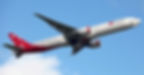
Launched as a separate airline in 2009, V-Australia served long haul destinations in the USA from Sydney and Melbourne with a fleet of Boeing 777-300ER. (Photo:flight.org) On 10 January 2011, Virgin Blue entered a 10-year strategic alliance with Perth-based Skywest Airlines (now Virgin Australia Regional Airlines), to operate up to 18 new Virgin-branded turboprop aircraft from mid-2011. On 23 February, it was announced that the aircraft would be ATR-72s, to enter service beginning in May 2011; they would allow Virgin Australia to both replace its fleet of Embraer 170s and introduce new regional routes.
In February 2011, a re-brand was confirmed when the airline announced that the word 'Blue' would be dropped from its name as part of a campaign to attract more business travellers away from rival Qantas. This came shortly after the unveiling of new crew uniforms and business-class seats. The airline stated that the re-brand would proceed in stages and would reportedly include a new fleet livery and the renaming of the other Virgin Blue Group airlines would be integrated as well. On 4 May 2011, the former Virgin Blue revealed its new name, Virgin Australia. In addition to the new name, branding and livery, the airline also showed off its new flagship the Airbus A330. Pacific Blue and V Australia were both folded into the new Virgin Australia brand, following an agreement with former Virgin Atlantic shareholder Singapore Airlines. In May 2011 the airline announced its intention to operate Airbus A330 aircraft between Perth and the East Coast. On 20 January 2011, Air New Zealand announced it would take a shareholding stake of between 10% and 14.99% in Virgin Australia.

As part of its regional operations the ATR-72 was introduced in mid 2011. (Photo:http://australianaviation.com.au) 
In the first half of 2011, it rebranded as Virgin Australia, it also started operations with wide-body Airbus A330. (Photo:virginaustralia.com) On 11 April 2013, Virgin Australia completed its acquisition of regional airline Skywest Airlines. Skywest was then renamed Virgin Australia Regional Airlines and took over all regional flights including the fleet of ATR and Embraer aircraft.
On 31 May 2016, Chinese aviation holding company HNA Group agreed to purchase 13% of Virgin Australia Holdings which ultimately intends to increase to 19.99%. The deal also created a codeshare partnership between Virgin Australia and Chinese airlines in which HNA Group holds shares, on routes between Australia and China. Virgin intended to launch flights between Australian destinations and Beijing and Hong Kong by 2017 to consolidate the agreement. On 4 April 2018, Air New Zealand announced the end of the code- and revenue-sharing partnership with Virgin Australia, effective 28 October 2018.

The airline rebranded all its planes in the new colours, like this B737-800. It started to offer WIFI connectivity, dedicated business class seating and a better overall service.(Photo: planepictures.net) 
As Virgin Australia took over Skywest in 2013, it flew some older types like the Fokker 100, retired finally in 2026. (Photo: Jetphotos.com) 
The A320 also joined in 2013, though it will be replaced by newer Boeing aircraft from 2022. (Photo: Planespotters.net) In August of 2018, Virgin converted 13 of its 737 MAX 8 orders for the larger MAX 10 variant. Deliveries of the MAX 10 were scheduled to begin in 2022, but were delayed till 2027, because of the grounding of the type in late 2019 and later the pandemic of 2020.
In 2019, the airline continued to reposition itself from a low-cost carrier into a full-service competitor to Qantas, investing heavily in widebody aircraft such as the Boeing 777 and Airbus A330, expanding long-haul routes to destinations including Los Angeles and Hong Kong, and introducing premium products.
The turning point came in April 2020, when the COVID-19 pandemic triggered a collapse in global air travel. Border closures and a sharp decline in passenger demand pushed Virgin Australia into voluntary administration, marking one of the most significant airline failures in Australian history. Unlike some competitors globally, the airline did not receive a government bailout, largely due to its foreign ownership structure. Instead, after a competitive bidding process, the US private equity firm Bain Capital acquired the airline in June 2020.
Following the acquisition, Bain initiated a sweeping restructuring program that fundamentally reshaped the airline’s business model. Branded informally as “Virgin Australia 2.0,” the strategy focused on simplifying operations and returning the airline to profitability. The airline retired its widebody fleet—including Boeing 777s and Airbus A330s—as well as regional ATR aircraft, and permanently shut down its low-cost subsidiary Tigerair Australia. The fleet was simplified to primarily Boeing 737 narrowbody aircraft.
Leadership changes accompanied this transformation. In late 2020, CEO Paul Scurrah stepped down and was replaced by Jayne Hrdlicka, who had previously held senior roles at Qantas. Under her leadership, Virgin Australia adopted a “value carrier” strategy—positioned between full-service and low-cost airlines.
Throughout 2021 and 2022, the airline focused on rebuilding its domestic network as Australia gradually reopened. International operations remained limited, but strategic partnerships became central to its global connectivity. A key development was the announcement in December 2021 of a new alliance with United Airlines, replacing its long-standing partnership with Delta Air Lines.

As the airline awaited deliveries of the newer Boeing Max, it leased more Boeing 737-800 to scale up its operations after the pandemic started to subside in 2022. (Photo: Planespotters.net) As travel demand rebounded after the pandemic, Virgin Australia cautiously expanded selected short-haul international routes, particularly to leisure destinations in the Asia-Pacific region. Routes such as Gold Coast–Denpasar (Bali) and Cairns–Tokyo were introduced or relaunched between 2022 and 2023.
Virgin Australia officially introduced a new type of aircraft into its fleet on June 28, 2023, with the delivery of its first Boeing 737-8 MAX. The aircraft, registered as VH-8IA and affectionately named "Monkey Mia," touched down in Brisbane. The inaugural flight took place between Cairns and Tokyo (Haneda) in July 2023. The 737-8 MAX reduces carbon emissions by at least 15% and is 40% quieter than the older 737-800 NG models. During the next years the airline would continue to take on deliveries of the Max type with the -10 version delayed till 2027.

From June 2023, new Boeing 737 Max 8 started to arrive for virgin Australia and operated its first flight from Cairns to Tokyo. (Photo: Planespotters.net) In 2024, the airline placed an order for Embraer E190-E2 jets, with deliveries beginning in 2025. These aircraft were intended to replace aging Fokker 100 jets and expand services in Western Australia’s lucrative fly-in fly-out (FIFO) mining sector, demonstrating a renewed focus on profitable niche markets.
In 2024, regulatory approval was granted for a renewed codeshare partnership with Air New Zealand on trans-Tasman routes, strengthening connectivity between Australia and New Zealand. Meanwhile, Qatar Airways agreed to acquire a 25% stake in Virgin Australia, a deal approved in early 2025. This investment signalled a potential pathway back into long-haul international markets through partnership rather than direct fleet expansion.
In parallel, the airline prepared for a return to public markets. After five years under private ownership, Virgin Australia launched an initial public offering in 2025, reflecting improved financial performance and market confidence. Leadership transitions continued during this phase, with CEO Jayne Hrdlicka announcing her departure in 2024 and Dave Emerson taking over in 2025, marking the next stage of the airline’s evolution.
Virgin Australia welcomed the improved Embraer E190-E2 to its fleet on September 6, 2025, arriving at its new home base in Perth two days after. Following a series of proving flights, the E2 officially entered commercial service on October 27, 2025.

Virgin Australia introduced the Embraer E190-E2 to its fleet on September 6, 2025, arriving at its new home base in Perth two days after. (Photo: Planespotters.net) Looking toward the future, Virgin Australia’s strategy appears focused on disciplined growth rather than aggressive expansion. Fleet plans centre on incremental modernization, particularly through the introduction of Embraer E190-E2 aircraft for regional operations and continued reliance on Boeing 737s MAX for mainline services. The airline has not signalled a return to operating its own widebody long-haul fleet in the near term; instead, it is expected to expand international connectivity through partnerships, especially with Qatar Airways and United Airlines.
Route development is likely to continue prioritizing high-demand leisure destinations in Asia and the Pacific, alongside strengthening core domestic routes linking major Australian cities such as Sydney, Melbourne, and Brisbane.

Virgin Australia focuses on being "Australia’s most loved airline" by blending professional service with its signature "Virgin Flair." Since its 2020 relaunch its set to provide many more years of great flying experience! (Photo: virginaustralia.com)
Airline Factual Information
As of May 2026, Virgin Australia serves 33 domestic destinations across Australia and has expanded its international footprint to 7 destinations, including its flagship long-haul service to Doha, Qatar, alongside regional routes to Fiji, Indonesia, New Zealand, Samoa, and Vanuatu. This network covers a total of 7 countries, including Australia.
Virgin Australia has 3 main bases in Australia, Sydney, Melbourne and Brisbane. It is the second largest carrier in Australia and flies mostly domestic routes where it has an extensive network all over Australia, as well as flying to the Pacific.
Virgin Australia, currently flies to the following destinations*:
Region 🗺️
Destinations 🌍🌎🌏
Domestic
• Australia: Adelaide, Alice Springs, Ayers Rock, Ballina, Brisbane, Broome, Cairns, Canberra, Darwin, Emerald, Exmouth, Gladstone, Gold Coast, Hamilton Island, Hobart, Kalgoorlie, Karratha, Kununurra, Launceston, Mackay, Melbourne, Mount Isa, Newcastle, Newman, Onslow, Perth, Port Hedland, Proserpine, Rockhampton, Sunshine Coast, Sydney, Townsville, Wollongong
Oceania
• Fiji: Nadi • New Zealand: Queenstown • Samoa: Apia • Vanuatu: Port Vila
Asia
• Indonesia: Denpasar
Middle East
• Qatar: Doha (operated by Qatar Airways)
*Updated May 2026
The airline did utilise a mix fleet in a bid to compete with other established carriers in the Australian market, however with its relaunch in 2020 under a different parent company it has shifted to a more streamline fleet operation with a single type, the Boeing 737 with its variants.
It does also operate the Airbus A320 (ex Tiger Airways Australia) and newer Embraer E190-E2 for its regional airline, Virgin Australia Regional Airlines. The fleet is well suited for all market segments of the Australian territory, deploying regional aircraft to the smaller communities and operating larger aircraft such as the B737 Max 8 for heavier demand routes such as Sydney/Melbourne to Perth.
It has new Boeing 737-10 Max on order scheduled for delivery from 2027.
The airline’s fleet* consists of the following aircraft, including those of Virgin Australia Regional Airlines:
Aircraft Type
In Service
On Order
Configuration (C, Y)
Airbus A320-200
4
0
(Y) 3-3
Boeing 737-700
9
0
(C) 2-2 / (Y) 3-3
Boeing 737-800
75
0
(C) 2-2 / (Y) 3-3
Boeing 737 MAX 8
14
9
(C) 2-2 / (Y) 3-3
Boeing 737 MAX 10
0
13
(C) 2-2 / (Y) 3-3
Embraer E190-E2
3
5
*Updated May 2026
(Configuration: C = Business Class, Y = Economy)


Reviews and comments ⭐
What Stands Out 😀👍 | Needs Improvement 🫤👎 |
✅ World-Class Crew: Passengers consistently highlight the cabin crew as the airline's greatest asset, frequently describing them as friendly, professional, and genuinely caring. | 👎 Paid In-Flight Catering: A common frustration among travellers is the "user-pays" food and beverage model on domestic flights, with many feeling the prices for sandwiches and snacks are too high. |
✅ Operational Reliability: Recent data and reviews commend the airline for its strong on-time performance and significantly lower cancellation rates compared to major competitors. | 👎 Ground Service & Support: Some passengers report negative experiences with "robotic" or inflexible ground staff at check-in and difficulties reaching customer service during disruptions. |
✅ Modern Cabin Interiors: The new Boeing 737 MAX fleet is well-received for its quiet engines, modern lighting, and convenient features like built-in tablet holders and USB charging ports. | 👎 In-Flight Entertainment Gaps: The transition away from seatback screens to a "stream-to-your-device" model has left some passengers underwhelmed, particularly due to the lack of a moving flight map. |
✅ Value for Money: Travelers often note that the airline provides a superior experience to budget carriers at a competitive price point, striking a good balance for both leisure and business. | 👎 Lounge Consistency: While many enjoy the domestic lounges, some frequent flyers have noted overcrowding during peak times or a lack of variety in the food offerings compared to previous years. |
✅ Smooth Booking & Check-In: Many users find the digital experience, including the app and self-service bag drop, to be intuitive and time-saving. | 👎 Unexpected Fees: There are occasional complaints regarding strict baggage weight enforcement and additional charges that can feel like "scamming" to less frequent travellers. |
*Reviews are collected from independent sites and compelled by the most representative reviews and comments. Planet Airlines Ltd remains impartial to any airlines.