

Airline Chronological History
Vietnam Airlines has its origins in January 1956, when it was established by the North Vietnamese government under the name Vietnam Civil Aviation following the nationalization of Gia Lam Airport. The airline was created as part of the air force for civilian purposes with support from both the Soviet Union and China; initially, its fleet consisted of two Lisunov Li-2s that were later replaced by two Ilyushin Il-14 and three Aero Ae-45s.

The Airline, known as Vietnam Civil Aviation, used the Lisunov Li-2s (The Russian version DC-3) in 1956. (Photo:wikivividly.com) 
Another early type to have been used was the Ilyushin Il-14, now part of the Museum grounds. (Photo:airliners.net) The airline's development and expansion was seriously damaged by the Vietnam War (1954–1975). But it did manage to still operate a selected number of flights and incorporate some airframes to support diplomatic flights during the war. The Sud Aviation SE-210 Caravelle III, commonly referred to as the Caravelle, was officially introduced to the South Vietnamese flag carrier, Air Viet Nam, on August 31, 1964. This arrival marked a significant leap into the jet age for civil aviation in the region. Following the unification of Vietnam, the aircraft transitioned into the fleet of the newly formed Hang Khong Viet Nam (the precursor to the modern Vietnam Airlines) in 1976, though its service in the post-war era was short-lived due to a shift toward Soviet-manufactured equipment.

In 1964 the Caravelle Groves, were some of the first jet aircraft to be operated for Air Viet Nam as it was known back then. (Photo:wikivividly.com) Other early aircraft operated by Air Viet Nam as it was known back then where the Douglas C-54D and the Yakovlev Yak-40. These tri-jets became the workhorses for domestic legs, such as flights between Qui Nhon and Ho Chi Minh City, throughout the 1980s and 1990s. (The type remained in service for over two decades until the final examples were retired and stored in 1999)

The airline operated brifly types such as the Douglas C-54D, in 1975. (Photo:wikivividly.com) 
The Yakovlev Yak-40 also formed part of the fleet, used primarily on domestic services. Now part of the museum of aviation. (Photo:wikimedia.org) Following the war, its first international destination was Beijing, followed by Vientiane in 1976. During that year, the airline was known as General Department of Civil Aviation in Vietnam.
The Ilyushin Il-18, was a cornerstone of the early Vietnam Airlines fleet, it was officially introduced to service in 1970. The airline utilized the Il-18 to significantly expand its medium-haul capabilities. These Soviet-built turboprops remained the backbone of the carrier's international operations for over two decades, famously serving routes to destinations like Beijing and Vientiane.
Vietnam Airlines, also introduced the Boeing 707 as a foundational part of its international fleet during the late 1970s and 1980s. The aircraft remained a staple of Vietnam Airlines' long-haul operations throughout the 1980s. (By April 1995, official fleet records indicated that the airline still maintained two Boeing 707-300s in its inventory, before they were eventually phased out by newer widebodies like the Boeing 767).

During the 1970's the Ilyushin Il-18s were introduced to the early fleet of Vietnam Airlines and helped to open routes to Beijing. They went on flying right into the 1990's. (Photo:airplane-pictures.net) 
The Boeing 707-300 operated long haul routes from late 1970's to the 1990's. (Photo:airliners.net) In 1978, another important destination of Vietnam Airlines was added, with flights offered to Bangkok. The late 1980s and early 1990s saw the expansion of the network to Hong Kong, Kuala Lumpur, Manila and Singapore.
In 1990, the company initiated discussions regarding the incorporation of Western built aircraft into the fleet. Which was still banned, being one of the consequences after the war. However, the carrier had to cancel the acquisition of two Airbus A310s due to their use of US-manufactured engines. By July 1991, Vietnam Airlines organized a similar but more complicated deal with TEA Basle, who spent the rest of 1991 negotiating a deal with US authorities. Eventually, a solution stating that "[the Boeing 737] must be positioned outside Vietnam, with no logo or lettering of Vietnam Airlines. On these conditions, it could operate on behalf of Vietnam Airlines".
In December 1991, Cathay Pacific and Vietnam Airlines agreed on a 50–50 joint venture to operate between Hong Kong and Vietnam, as the airline's Tupolev Tu134 fleet did not meet Kai Tak Airport's noise restrictions.
Vietnam Airlines modernized its regional operations significantly during the early 1990s as it tried to transition from Soviet-era aircraft to Western-built turboprops. It was not able to buy Amercian planes yet, but European manufactures were able to trade with Vietnam. So did the airline purchased in mid-1992, the ATR 72 variant to serve domestic routes with lower passenger demand. The first ATR 72 was introduced to the fleet on May, 1992. (it went on to operate 26 units of the type between the smaller 42 and the 72 variants).

With more access to western types, newer ATR-72 turboprop aircraft arrived in 1992. (Photo:airliners.net) In October 1992, the Boeing 737 was supplemented with an Airbus A310. However, with repair issues after the aircraft sustained an engine failure it led Vietnam Airlines to switch from Airbus to Boeing. Hence, a Boeing 767-200ER, leased from Ansett Worldwide Aviation Services (AWAS), arrived in January 1993, and a Royal Brunei Airlines Boeing 767-300ER, arrived the following year.

Soviet planes were still operated in 1992, as this Tu-134 for regional flights. (Photo:wikimedia.org) 
Leased Boeing 767-600 were incorporated in 1993. (Photo:wikimedia.org) In October 1993, the first Airbus A320-200 was incorporated over a two-year wet-lease contract with Air France. Vietnam Airlines by now had started discussions with Air France about a partnership, and the French carrier agreed to lease its Airbuses to Vietnam Airlines, and also to provide customer support and pilot/crew training. By that time the route network had further expanded internationally, seeing the incorporation of destinations such as Paris, Tokyo, Seoul, Taipei, Sydney, and Melbourne.

Vietnam Airlines leased Airbus A320 from Air France in 1993 to retire older soviet types. (Photo:wikimedia.org) The airline became the flag carrier of Vietnam in 1993, after having completed a restructuring programme that was started four years earlier. In that year, the airline split from the Civil Aviation Administration of Vietnam (CAAV) and became a state enterprise. In February 1994, US President Bill Clinton lifted the trade embargo to allow Vietnam Airlines the ability to acquire Western-built aircraft. Consequently, Vietnam Airlines announced in April of the same year that it would be phasing out its inefficient Soviet planes. By April 1995, the fleet consisted of nine Airbus A320s (all of them leased from Air France), 11 Antonov An-24s, four ATR72s, two Boeing 707-300s, three Ilyushin Il-18s, nine Tupolev Tu-134s and three Yakovlev Yak-40s.
On 27 May 1995, the airline, along with a number of other aviation-related businesses, were incorporated to establish Vietnam Airlines Corporation. Two Fokker 70s were purchased in mid-1995, they were aimed at partly replacing the Tu134 fleet on domestic routes. In December 1995, discussions with GECAS for the lease of three additional, second hand Boeing 767-300ERs were under way; these ex-Continental Airlines aircraft would act as a replacement for the previous operated Boeing 767's.

With the lifting of the embargo in 1994, Vietnam Airlines was able to purchase and fly it's own aircraft. The Fokker 70's were a new addition in 1995. (Photo:wikimedia.org) In September 1996, Vietnam Airlines started offering business class services and in 1999, the airline launched its frequent-flyer program, Golden Lotus Plus. In February 1996, GECAS delivered the first of three Boeing 767-300ER to the carrier, on dry-lease for five years. In May 2001, the first Airbus A321 joined the airline, making for the replacement of older types and leased A320.

In February 1996, improved and updated Boeing 767-300ER were leased to Vietnam Airlines for five years. (Photo: airhistory.net) 
In May 2001, the first Airbus A321 joined the airline. (Photo: airhistory.net) In December 2001, Vietnam Airlines signed a historic agreement with Boeing for the acquisition of its first ever US-built aircraft, four B777-200ER, signalling the start of trade under the Bilateral Trade Agreement between the two countries. During 2002, Vietnam Airlines considered a lease offer from Airbus for two Airbus A340-300s although it never materialised.
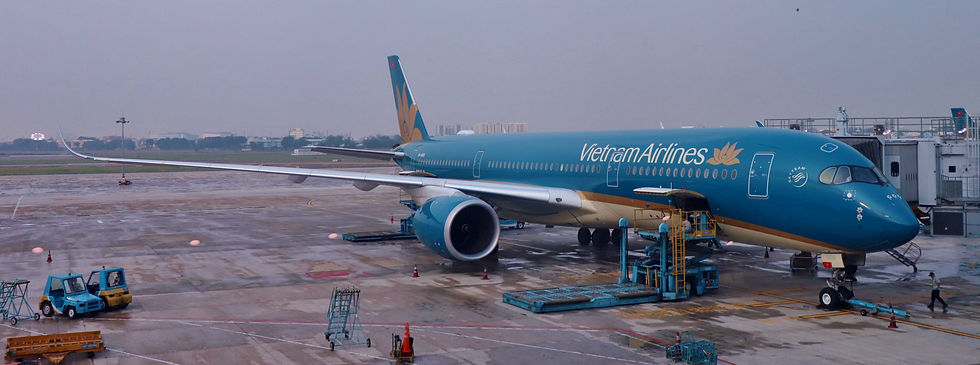
On October 20, 2002, Vietnam Airlines officially unveiled its "Golden Lotus" corporate identity, marking a sophisticated shift in its global branding that was fully implemented across the fleet on November 1, 2002. This transformation replaced the previous "stork and sun" emblem with a stylized golden lotus flower, a symbol of Vietnamese culture representing purity and resilience. The rebranding introduced a striking new livery characterized by a deep teal blue fuselage and a prominent gold lotus on the tail fin.
This overhaul was not merely aesthetic; it signalled the airline's modernization and its transition into a world-class carrier, coinciding with the arrival of its first Boeing 777-200ER aircraft on the 4th September 2003 and a commitment to elevated service standards.

In September 2003, Vietnam Airlines accepted the delivery of the first long haul Boeing 777-200ER together with a revised fresh logo and branding. (Photo: Airplane-Pictures.net) In June 2005, Vietnam Airlines ordered four Boeing 787-8s. Twelve additional 787-8s were then ordered in late 2007, some of them to be directly acquired from the Boeing company. These new aircraft were to allow Vietnam Airlines to expand its network and replace some leased aircraft. In 2010 the airline switched its Boeing 787 order from the –8 to the –9 model.
On 20 June 2005, the airline launched direct services to Frankfurt after having discontinued services to Berlin. On 1 October 2007, the airline and VALC signed a memorandum of understanding for the purchase of ten Airbus A350 XWBs, and 20 additional Airbus A321s. It was also in 2007, that the airline received its first A330, until the newer equipment arrived. The Airbus A350s will supplement the Boeing 787s already ordered by the airline. The two companies also ordered five extra ATR 72-500s in December 2007. In August 2008, Vietnam Airlines added Nagoya, the airline's fourth point served in Japan besides Fukuoka, Osaka and Tokyo, to the route network.

At the turn of the century, the Airbus A321 was the aircraft of choice for Vietnam Airlines to fly regional and intra-asian flights with more deliveries throughout the decade. (Photo:planepictures.net) 
First arrived in 2007, the Airbus A330 supplemented the fleet with the expansion of the airline whilst it waited for B787-9 and Airbus A350. (Photo:planepictures.net) In 2009, Vietnam Airlines and the Government of Cambodia established a joint venture, having 49% and 51% stockholding, respectively, with the goal of boosting tourism in Cambodia. The joint-venture was a new Cambodian national airline named Cambodia Angkor Air, which started flying in July the same year, using ATR-72 aircraft, and Airbus A321. Also in 2009, the carrier signed a deal for another 16 Airbus A321s plus two Airbus A350s, during the Paris Air Show. Vietnam Airlines joined SkyTeam on 10 June 2010. In February 2012, Vietnam Airlines boosted its stake in the low-cost carrier Jetstar Pacific Airlines to 70%, with Qantas holding the balance.

In 2009, Vietnam Airlines and the Government of Cambodia established a new Cambodian national airline named Cambodia Angkor Air, which started flying in July using ATR-72. (Photo: Planespotters.net) 
Vietnam Airlines joined SkyTeam on 10 June 2010 and to mark the occasion it painted this Airbus A321-200 in the colours of the alliance. (Photo: airhistory.net) In late April 2012, the aircraft lessor ALC announced the placement of an order for eight Boeing 787-9s, which will be leased to Vietnam Airlines. In July 2014, a new route to Tokyo-Haneda from Hanoi was introduced. Vietnam Airlines received its first Airbus A350-900 in late June 2015, becoming the second operator of the type worldwide after Qatar Airways. In August 2015, the airline's first Boeing 787-9 entered the fleet. London operations were transferred from Gatwick to Heathrow in 2015, operating its new Boeing 787-9 aircraft.

The Airbus A350-900 joined in June 2015, improving the service and operations. (Photo:planepictures.net) 
Also in August 2015, the Boeing 787-9 was incorporated renewing the long haul fleet. (Photo:planepictures.net) In November 2018, the carrier took ownership of its first Airbus A321neo for its short and medium haul routes. With it's growth expansion plan, Vietnam Airlines was aiming to become the second-largest full-service carrier in Southeast Asia.
The airline then launched flights to London-Gatwick (where it had previoslu operated), Beijing and Shanghai, as of April 2018, it also re-opened flights to Berlin, and commenced flights to Adelaide, Perth, Amsterdam, Milan, Prague, Mandalay, Dalian, Nanjing, Hangzhou.

The advanced Airbus A321 Neo, was incorporated into the fleet in November 2018. (Photo: Airplanepictures.net) A new type joined the Vietnam Airlines fleet in the Summer of 2019, as the biggest member of the Dreamliner family, the Boeing 787-10 helped the airline increase seating capacity on its most popular routes and opened up new ones, potentially to the USA, as the airline was planning at the time.
The newest aircraft for the Vietnamese airline was the Boeing 787-10, which joined the fleet in the Summer of 2019. (Photo: Jetphotos.com) In 2019, Vietnam Airlines was in the midst of a fleet transition and modernization strategy. That year marked the retirement of its remaining Airbus A330 aircraft, symbolizing a shift toward a more fuel-efficient wide-body fleet centered on the Airbus A350 and Boeing 787 Dreamliner families.
The outbreak of COVID-19 in early 2020 marked a dramatic turning point. Like most global carriers, Vietnam Airlines experienced a severe collapse in international passenger demand due to border closures and travel restrictions. Throughout 2020 and 2021, the airline was forced to suspend or drastically reduce most of its international routes, shifting its focus toward domestic travel and limited repatriation flights. Fleet utilization declined sharply, and the airline began reassessing its asset portfolio, including plans to retire or sell older aircraft such as Airbus A321ceo models and ATR72 turboprops.
Despite these difficulties, the airline made a significant move on the 21 November 2021 by launching its first-ever nonstop route between Vietnam and the United States, connecting Ho Chi Minh City with San Francisco initially with the Boeing 787-9 and then supplementing flights with the Airbus A350-900. This route represented a major strategic milestone, not only expanding the airline’s intercontinental network but also symbolizing Vietnam’s growing economic and aviation ties with North America.

With many years on the planning, finally Vietnam Airlines launched its first service to the USA on the 21 November 2021, connecting Ho Chi Minh City with San Francisco initially with the Boeing 787-9. (Photo: planespotters.net) As global travel began to recover in 2022, Vietnam Airlines gradually reinstated international services and resumed expansion. The airline rebuilt its route network across Asia, Europe, and Australia while benefiting from pent-up travel demand. In 2023, Vietnam Airlines signed a memorandum of understanding with Boeing for the purchase of 50 Boeing 737 MAX 8 aircraft, marking its first major narrow-body order from Boeing and a shift toward diversifying its supplier base.
By 2023 and 2024, the recovery had accelerated significantly. The airline also began taking delivery of additional modern aircraft, including more Boeing 787-10 Dreamliners and new Airbus A320neo and A321neo aircraft, enhancing both long-haul and short-haul capacity. The first Airbus A320neo arrived on July 7, 2024.

The airline officially welcomed its first Airbus A320neo on July 7, 2024. (Photo: planespotters.net) Financially, the airline’s recovery culminated in record-breaking performance by 2024 and 2025. In 2024, Vietnam Airlines returned to profitability, and by 2025 it achieved the highest revenue in its history, exceeding VND120 trillion (approximately $4.6–4.7 billion).
Vietnam Airlines continued expanding its route network. One of the most notable developments was the planned launch of the nonstop Hanoi–Amsterdam route in 2026, operated using Airbus A350 aircraft. The airline has also focused on increasing frequencies and optimizing connections across its domestic and Asian networks, linking key destinations such as Da Nang, Nha Trang, and Phu Quoc with international hubs.
Looking towards the future, Vietnam Airlines has outlined an extensive fleet and network expansion strategy that will shape its development through the 2030s. Central to this plan is the large-scale acquisition of new aircraft, including up to 50 Boeing 737-8 jets valued at approximately $8.1 billion, which will form the backbone of its next-generation narrow-body fleet. Deliveries are expected to begin around the end of the decade,
These fleet investments are closely tied to network expansion plans. Vietnam Airlines aims to further develop its intercontinental routes, particularly to Europe and North America, while also deepening its presence in high-growth markets across Southeast Asia, Northeast Asia, and Oceania. At the same time, it is pursuing a broader strategic goal of becoming a “five-star international airline” by 2030, focusing on service quality, operational efficiency, and global competitiveness.

Vietnam Airlines is pursuing a broader strategic goal of becoming a “five-star international airline” by 2030, focusing on service quality, operational efficiency, and global competitiveness. (Photo: Vietnamairlines.com)
Airline Factual Information
Vietnam Airlines currently operates an expansive flight network serving 22 domestic destinations within Vietnam and 35 international destinations across the globe as of 2026. This network spans a total of 20 countries and territories.
Recent expansions have further strengthened the carrier's global footprint, including the launch of new direct routes to major European hubs like Amsterdam and Munich and San Francisco back in 2021, its only USA gateway for now.
Vietnam Airlines has two major bases where it flies most of it's flights, Hanoi and Ho Chi Minh City equally act as major bases where the airline flies to it's international destinations. Some of its destinations are flown on alternative days to offer more choice to the traveller visiting Vietnam. This gives more flexibility and ease of connections spread into two hubs.
Vietnam Airlines, flies to the following destinations*:
Region 🗺️
Destinations 🌍🌎🌏
Domestic
• Vietnam: Buon Ma Thuot, Ca Mau, Can Tho, Chu Lai, Con Dao, Da Lat, Da Nang, Dien Bien Phu, Dong Hoi, Haiphong, Hanoi, Ho Chi Minh City, Hue, Nha Trang, Phu Quoc, Pleiku, Qui Nhon, Rach Gia, Thanh Hoa, Tuy Hoa, Vinh
East Asia
• China: Beijing, Chengdu, Guangzhou, Hangzhou, Shanghai, Shenzhen • Hong Kong: Hong Kong • Japan: Fukuoka, Nagoya, Osaka, Tokyo • South Korea: Busan, Seoul • Taiwan: Kaohsiung, Taipei
Southeast Asia
• Cambodia: Phnom Penh, Siem Reap • Indonesia: Jakarta • Laos: Luang Prabang, Vientiane • Malaysia: Kuala Lumpur • Myanmar: Yangon • Singapore: Singapore • Thailand: Bangkok, Phuket
Europe
• France: Paris • Germany: Frankfurt, Munich • United Kingdom: London LHR
Oceania
• Australia: Melbourne, Perth, Sydney
North America
• United States: San Francisco
*Updated May 2026
Vietnam Airlines operates one of the most advanced and modern fleets of any Asian airline now a days. It has a modern up to date product and all it's aircraft are delivered new to the airline. It prides itself to have one of the youngest fleets in the Asian continent. It combines both Airbus and Boeing aircraft in its operations for long haul flights and the Airbus A320neo and A321-200/neo for all its short and medium haul destinations.
The airline plans to shift to an all Boeing short haul fleet by introducing the Boeing 737-8 Max to its fleet in the next decade and replacing the A321 classics.
Vietnam Airlines currently flies the following aircraft in its fleet*:
Aircraft Type
In Service
On Order
Configuration (C, P, Y)
Airbus A320neo
3
1
(C) 2-2 / (Y) 3-3
Airbus A321-200
42
0
(C) 2-2 / (Y) 3-3
Airbus A321neo
20
0
(C) 2-2 / (Y) 3-3
Boeing 737 MAX 8
0
50
(C) 2-2 / (Y) 3-3
Airbus A350-900
14
0
(C) 1-2-1 / (P) 2-4-2 / (Y) 3-3-3
Boeing 787-9
11
0
(C) 1-2-1 / (P) 2-3-2 / (Y) 3-3-3
Boeing 787-10
6
2
(C) 1-2-1 / (Y) 3-3-3
*Updated May 2026
(Configuration: C = Business Class, P = Premium Economy , Y = Economy)


Reviews and comments ⭐
What Stands Out 😀👍 | Needs Improvement 🫤👎 |
✅ Professional and Attentive Crew: Passengers frequently praise the cabin staff for their warm hospitality, polite way, and efficient service, particularly on long-haul routes. | 👎 Unpredictable Delays and Cancellations: A common grievance is the frequency of flight schedule changes and cancellations, often with minimal advance notice or poor communication regarding the cause. |
✅ Quality In-flight Dining: The airline is often commended for its flavourful and generous meal portions, with many travellers highlighting the authentic Vietnamese cuisine served even on shorter regional flights. | 👎 Inconsistent Ground Service: Many reviews point to "catastrophic" customer service at airport counters, citing unhelpful staff during check-in, layovers, or when resolving booking and name-correction issues. |
✅ Modern Wide-body Comfort: Travelers on the Boeing 787 Dreamliner and Airbus A350 often report high satisfaction with the cabin cleanliness, spacious seat pitch in Premium Economy, and the 1-2-1 layout in Business Class. | 👎 Technical and IFE Glitches: Frequent complaints focus on aging or malfunctioning In-flight Entertainment (IFE) screens, broken footrests, and unreliable onboard Wi-Fi, even on relatively new aircraft. |
✅ Efficiency of Regional Connections: Many domestic travellers appreciate the frequent flight schedule and the affordability of tickets for internal travel across Vietnam's major cities. | 👎 Poor Irregular Operations Handling: Passengers have expressed strong dissatisfaction with how the airline handles diversions or lost luggage, often describing a lack of local support and difficult reimbursement processes. |
✅ Generous Amenities in Premium Classes: Business Class and Premium Economy passengers often highlight the quality of bedding, noise-cancelling headphones, and the variety of drinks as standout features. | 👎 Intrusive In-flight Advertising: Some passengers find the length and frequency of airline promotional videos and long PA announcements during the flight to be distracting and excessive. |
*Reviews are collected from independent sites and compelled by the most representative reviews and comments. Planet Airlines Ltd remains impartial to any airlines.