

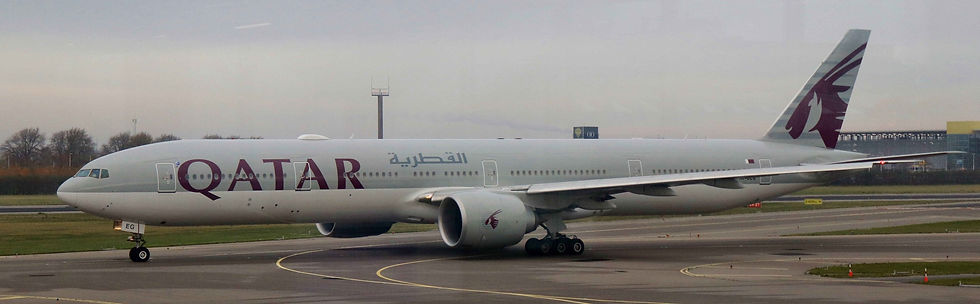
Airline Chronological History
Qatar Airways is the national airline of the State of Qatar and one of aviation industry’s big success stories. Operations began in 1994 when the airline was a small regional carrier serving a handful of routes. The airline was re-launched in 1997 under the mandate of His Highness The Father Emir, who outlined a vision to turn Qatar Airways into a leading international airline with the highest standards of service and excellence.
Qatar Airways has come a long way since it was established on November 22, 1993 and then started operations on January 20, 1994. Amman was first served in May 1994. By this time the fleet consisted of two Airbus A310s that served a route network including Abu Dhabi, Bangkok, Cairo, Dubai, Khartoum, Kuwait, Madras, Manila, Muscat, Osaka, Sharjah, Taipei, Tokyo and Trivandrum. During 1995, two ex-All Nippon Airways Boeing 747s were bought from Boeing. The airline acquired a second-hand Boeing 747SP from Air Mauritius in 1996 also to expand operations.

Boeing 727's were used in the initial years of Qatar Airways until they were retired in 2001. (Photo: airhistory.net). Flights to London were launched during 1997. The airline also took delivery of two second-hand Airbus A300-600R, during the year; they replaced two Boeing 747s. The entering of these two A300s into the fleet also marked the introduction of a new logo.
A third A300-600R joined the fleet shortly afterwards. In July 1998 the carrier placed a firm order with Airbus for six Airbus A320s; it also took options for five more aircraft of the type. These latter four aircraft were aimed at replacing the Boeing 727-200 fleet and to fill the capacity gap before the hand over of the first A320.
One of Qatar Airways’ three 747s at Gatwick in 1996. (Photo: simpleflying.com) 
Airbus A310 were used initially on Qatar Airways first long haul routes until they were replaced with larger Airbus A330 and A340-600. (Photo: Airliners.net) In 1999, Qatar Airways undertook a significant step in redefining its corporate identity by introducing a new logo and updated aircraft titles. The rebranding in 1999 saw the introduction of the now-iconic Oryx emblem, a symbol of Qatar’s national heritage, prominently displayed on the tail of its aircraft. The airline also took delivery of the first A320 in February 1999 with the new livery applied.

The Airbus A320's came into operation in 1999, also with new logo and titles similar to those today. (Photo: Wikiwand.com) A fourth A300-600R, joined the fleet in April 2000. In October 2000, Qatar Airways ordered an Airbus A319CJ and took an option for another aircraft of the type. The airline became the Airbus A380's ninth customer in 2001 when two aircraft of the type were ordered, plus two options. Also that year, the airline resumed services to Jakarta. In 2002, the government of Qatar withdrew from Gulf Air. In June 2003, a Qatar Airways Airbus A320 was the first aircraft that resumed the international services to Iraq when it flew the Doha–Basra route. Also that month, Qatar Airways incorporated its first dedicated cargo aircraft to the fleet. It was one of the Airbus A300-600R that was converted to freighter.

Qatar Airways A300's where common in airports around the world from Europe to Asia until 2006.(Photo: Wikiwand.com) From the beginning of the new century, Qatar Airways, entered an era of ambitious expansion. In June 2003, at the Paris Air Show, the carrier placed an order with Airbus for two Airbus A321s, 14 Airbus A330s and two Airbus A340-600s. The deal included eight A330-200s and six -300s. The first aircraft were scheduled to enter the fleet in 2004, with the A340-600 slated for delivery in 2006.
During the year the airline started serving the Chinese market with the introduction of flights to Shanghai. Also in 2003, the carrier expanded its portfolio of destinations with the commencement of services to Manchester in April and Cebu and Singapore in December. During the 2003 Dubai Air Show the airline firmed up an earlier commitment for two Airbus A380s and took options for another two of these aircraft.

The short haul fleet was complemented by the Airbus A319. However, it was not used much and remained for charter flights. (Photo: Planepictures.net) 
In 2002 Qatar Airways received its first A330-200 which enabled it to reach more destinations. (Photo: Planepictures.net) The Qatar Airways Group —which included Qatar Airways, Doha International Airport and corporate business air services, ground handling and in-flight catering companies— reported its first profit ever for the fiscal year that ended on March 2004. Zurich became the carrier's 53rd destination worldwide in July 2004. Yangon was added to the list of destinations in December the same year. A new service to Osaka was launched in March 2005. Its first A340 was delivered on September 8, 2006.
2006, marked the introduction of a new and bolder logo and after the redesign, the logo became more colourful and varied. The name of the company appeared on it in two versions: in English and Arabic. The designers enlarged the image of the Arabian oryx and placed it in a dashed circle.

In 2006, Qatar Introduced a new bolder livery as also received it's new A340-600 which it used on long and ultra long haul routes. (Photo: Planepictures.net) In May 2007, Qatar Airways and Airbus signed a memorandum of understanding (MoU) for the acquisition of 80 Airbus A350 XWBs, including 20 A350-800s plus 40 and 20 aircraft of the –900 and –1000 variant, respectively, with the first aircraft initially slated for delivery in 2013. The agreement was firmed up in June during the 2007 Paris Air Show; three more Airbus A380s were also made part of the order. In July the same year, during the unveiling ceremony of the Boeing 787 in Everett, Qatar Airways was recognised as a future customer for the type when its logo appeared on one side of the brand new aircraft. By that time, the airline had not acknowledged it had placed an order for a number of these new aircraft.
In November the same year, a firm order for 30 Boeing 787-8s, plus options for 35 more aircraft of the –9 or –10 variant, was confirmed. The order also included 14 Boeing 777-300ERs, six Boeing 777-200LRs and seven Boeing 777Fs, whereas five more aircraft of the type were on option. The airline took delivery of its first 335-seater Boeing 777-300ER in late November 2007.
The route network grew further during 2007 with the incorporation of Newark in June, Nagpur —the carrier's seventh destination in India— in September, and Stockholm in November. A new scheduled service to New York-JFK that commenced in November 2008 replaced the Newark route. The first two Boeing 777-200LRs were handed over by the aircraft manufacturer in February 2009.
On June 15 the same year, at the Paris Air Show, Qatar Airways ordered 20 Airbus A320 and 4 Airbus A321 aircraft. On October 12, 2009, the company completed the world's first commercial passenger flight powered by a fuel made from natural gas. Also in 2009, Qatar Airways launched its first scheduled flights to Australia with Melbourne being the first city served; routes to Chengdu, Hangzhou, Phnom Penh and Clark International Airport in the Philippines were launched during 2009 as well.

For it's medium haul routes, mostly to the middle east and India, the airline used the A321 from 2007. (Photo: Planepictures.net) 
In February 2009, Qatar Airways received in first Boeing 777-200LR. (Photo: Planepictures.net) Tokyo-Narita was first served by the carrier in April 2010. On May 18, 2010, the airline put its first Boeing 777F (A7-BFA) into service, with a flight from Doha to Amsterdam. The airline launched 22 new destinations since 2010, with nine more destinations announced: Ankara, Aleppo, Bangalore, Barcelona, Brussels, Bucharest, Budapest, Buenos Aires, Copenhagen, Hanoi, Montreal, Nice, Phuket, São Paulo, Shiraz, Kolkata, Medina, Oslo, Sofia, Stuttgart, Venice and Tokyo. Qatar Airways also launched Benghazi and Entebbe during 2011. Service to Baku and Tbilisi, originally planned for 2011, was delayed until February 1, 2012.
Boeing's handover of a Boeing 777-200LR in September 2011 marked Qatar Airways receiving its 100th aircraft from this aircraft manufacturer. In November the same year, at the Dubai Airshow, the airline ordered 55 Airbus planes: 50 A320neo and 5 A380, in addition to two Boeing 777 freighters.
In July 2012, Perth became the second city served in Australia. On October 8, 2012, Qatar Airways announced it would join OneWorld within the forthcoming 18 months.
On November 12, 2012 Qatar Airways became the seventh carrier worldwide to acquire the Dreamliner, when Boeing handed over the airline's first aircraft of the type; it was the first delivered to a Middle Eastern airline. Dreamliner services on the long-haul Doha–London-Heathrow route commenced on Dec 13 2012, with the airline becoming the first one to offer regular services to the United Kingdom using this aircraft. During 2013, Qatar Airways launched flights to Gassim in Saudi Arabia, Basra and Najaf in Iraq, Phnom Penh, Salalah and Chicago. Services to Ethiopia began in September 2013.

Boeing 787-8's begun to appear in Qatar Airways colours from Nov 2012 as it continued in expansion plans. (Photo: Planepictures.net) In February 2013, Qatar Airways opened its European Customer Service centre, which is in Wrocław, Poland. In June 2013, the airline firmed up an order for two Boeing 777-300ER aircraft plus seven options. The joining ceremony to join the Oneworld alliance took place on the 29 October 2013 as Qatar Airways became the first major Persian Gulf carrier to join an airline alliance.
In October 2013, Qatar Airways joined the OneWorld Alliance and painted this Boeing 777-300ER in this special livery. (Photo: Planepictures.net) On November 17, 2013, the first day of the Dubai Airshow, Qatar Airways purchased 50 Boeing 777-9Xs. The commitment was firmed up during the 2014 Farnborough Air Show. In addition, the transaction included firm orders for four Boeing 777Fs plus options for another four.
An all-business class flight to London-Heathrow was launched in May 2014 with Airbus A319LR aircraft. Flights to Edinburgh were launched in May 2014. The carrier expected to take delivery of its first three Airbus A380 aircraft in June 2014. There were intentions to first deploy the type on the Doha–London-Heathrow route starting jun 17; another two undisclosed European points would likely become served with the A380. Delivery of the first aircraft of the type finally took place on 16 September 2014. A380 services to London commenced in October 2014.

In October 2014 Qatar received it's first A380 double decker, deployed first on its high yield route to London Heathrow. (Photo: Planepictures.net) The airline became the launch customer for the A350 XWB; the first Airbus A350-900 was handed over to the company on December 22, 2014 and had its first revenue flight to Frankfurt almost a month later, on January 15, 2015.

The first Airbus A350-900 was handed over to Qatar Airways on December 22, 2014 and had its first revenue flight to Frankfurt almost a month later. (Photo: Planepictures.net) In January 2015, the airline concluded an order for four Boeing 777Fs, and later that year ten Boeing 777-8Xs. Qatar Airways launched a new global brand campaign and tagline – Going Places Together – in New York, USA in 2015. The ‘Going Places Together’ campaign plays on the theme of achieving great things together whether for work, for family or for adventure, and encourages passengers to take journeys that will help them achieve their dreams and ambitions.
Between 2016 and 2018, Qatar Airways experienced a period of rapid expansion and strategic development, with the delivery of new-generation aircraft, including the Airbus A350-900 and the introduction of the larger Airbus A350-1000 later in 2018. The airline also expanded its Boeing fleet, taking delivery of additional Boeing 787-8 Dreamliners and Airbus A380s. During this period, Qatar Airways launched several new destinations, including Adelaide (May 2016), Helsinki (October 2016), and Marrakech (July 2016). Throughout 2017, Qatar Airways launched routes to destinations such as Dublin (June 2017), Nice (July 2017), Skopje (July 2017), and Prague (August 2017), while also acquiring a 49% stake in Italy’s Meridiana (later rebranded as Air Italy).
By 2018, the airline took delivery of its first Airbus A350-1000 in February 2018, becoming the launch operator of the type, and used it to upgrade services on key long-haul routes such as London Heathrow. Network expansion remained a priority, with new destinations including Cardiff (May 2018), Thessaloniki (March 2018), and Gothenburg (December 2018). Later, in November 2018, the airline announced it would expand its flights to Iran, landing at Tehran and Shiraz, as of January 2019, and to Isfahan in February.

In February 2018, Qatar Airways received its first A350-1000 for its high capacity routes and to replace older planes such as the Airbus A380 or Boeing 777-200LR. (Photo: Planepictures.net) In December 2018, the CEO of Qatar Airways, Akbar Al Baker, threatened to pull the company out of the Oneworld alliance in February, following accusations that alliance members Qantas and American Airlines engaged in "hostile business practices" against his carrier.
On April 30, 2019, Qatar Airways retired its last Airbus A340-600 from service after around 16 years of service. The last flight was QR835 from Bangkok to Doha. These Airbus A340-600 were replaced by the new next-generation long-haul Boeing 787-9 Dreamliner, which started to be delivered on the 27 December 2019.
The Boeing 787-9, was configured by Qatar Airways with a premium-heavy layout, including its award-winning Qsuite business class.

Boeing 787-9 Dreamliner's where accepted from December of 2019 and were vital to the companies operations as the Covid19 pandemic begun. (Photo: Planepictures.net) In February 2020, Qatar Airways acquired a 49% stake in Rwanda's flag carrier airline, RwandAir. The partnership was intended to be beneficial for both the airlines as it would provide technical and financial support to RwandAir for its development and hub strategy, while Qatar Airways would be able to bypass the embargo imposed by neighbouring countries. Other business investments, made Qatar Airways invests a 10% stake in the LATAM Airlines Group. And also own a 9.99% stake in Cathay Pacific.
In March 2020, when the COVID-19 pandemic hit, Qatar Airways stringently implemented the most advanced safety and hygiene measures, and, as the only global airline that never stopped flying throughout the COVID-19 pandemic, Qatar Airways accumulated unrivalled experience of how to safely and reliably carry passengers during these uncertain times. In December 2020, thanks to its varied fleet of modern aircraft that allowed Qatar Airways to respond quickly to market changes, the airline was able to rebuild its network from its lowest point in May, when Qatar served only 33 destinations, to over 110 destinations. Qatar Airways even launched seven new destinations during the pandemic to meet demand.
In June 2021, Qatar Airways launched its new Business Class Suite featured on Boeing 787-9 Dreamliner passenger aircraft on several key routes to Europe and Asia. Qatar Airways also offers the largest international network, which stood at over 140 destinations at the time, providing unrivalled connectivity to passengers and making it easy for them to change their travel dates or destination if they need to. On July 24, 2021, Qatar Airways resumed service to Cebu after eight years of absence.

In June 2021, Qatar Airways launched its new Business Class Suite featured on Boeing 787-9 Dreamliner passenger aircraft on several key routes to Europe and Asia. (Photo: Businesstraveller.com). In 2022, the airline entered a crucial recovery phase as international travel demand surged. This year was heavily shaped by operational ramp-up and global visibility, particularly through Qatar hosting the FIFA World Cup, which significantly increased passenger traffic and showcased the airline’s hub strategy. Simultaneously, Qatar Airways was still managing the aftermath of its high-profile legal dispute with Airbus over surface degradation issues on the Airbus A350 fleet. Although the dispute began earlier, its resolution in 2023 allowed the airline to restore grounded aircraft and stabilize long-haul capacity, a key turning point in its operational recovery. By 2022, the airline had also regained its position among the world’s leading carriers, winning the Skytrax “World’s Best Airline” title again, reinforcing its premium brand positioning.
Throughout 2023, Qatar Airways shifted decisively into expansion mode. The airline announced the launch of seven new destinations including cities such as Lyon, Toulouse, Trabzon, Medan, Chittagong, Kinshasa, and Juba, marking entry into entirely new markets like the Democratic Republic of the Congo and South Sudan. At the same time, it restored at least eleven previously suspended routes—including Beijing, Tokyo Haneda, Osaka, Birmingham, and Buenos Aires. By the end of 2023, Qatar Airways had returned to operating more than 170 destinations worldwide, effectively regaining and surpassing its pre-COVID network footprint.
By 2024, Qatar Airways introduced further network growth, including new European routes such as Hamburg and the resumption of Venice. The full restoration of the Airbus A350 fleet in 2024—after resolution of the earlier dispute—was particularly significant, as it restored one of the airline’s most efficient long-haul aircraft types and enabled further growth across Europe, Asia, and Africa.
Its fleet also expanded to approximately 284 aircraft by early 2024, reflecting both passenger and cargo operations. Fleet modernization continued with the operation of advanced aircraft such as the Airbus A350, Boeing 787 Dreamliner, and Boeing 777, alongside the introduction of newer narrow-body aircraft like the Boeing 737 MAX 8 in 2023 which only saw the type operate for just over 2 years. (see below)

Qatar Airways briefly operated the Boeing 737-8Max for 2 years as it solved an going dispute with Airbus about surface degradation and paint issues as its Airbus A320 and A350 were grounded. (Photo: Planespotters.net) The airline took delivery of its first 737-8 MAX on 15 April 2023, followed by additional aircraft in the months that followed. These jets were originally intended for Russian carrier S7 Airlines, but due to international sanctions imposed after February 2022 by the war in Ukraine, the aircraft could not be delivered.
The airline’s decision to introduce the 737-8 MAX was primarily driven by a capacity shortfall caused by the grounding of a significant portion of its Airbus A320neo family fleet. The situation got worse due to a dispute with Airbus over surface degradation and paint issues, which the airline argued posed potential safety concerns. This created an urgent need for narrowbody aircraft to maintain regional and medium-haul operations. However, the type was never intended as a long-term solution. In late 2023, Qatar Airways began phasing out the aircraft as its dispute with Airbus moved toward resolution and previously grounded A320neo aircraft gradually returned to service.
By 2025, Qatar Airways had fully retired the 737-8 MAX from its fleet, returning the aircraft to lessors or reallocating them within Boeing’s customer network.
On a another note after the recovery from the pandemic and the Airbus dispute, Qatar Airways invested in passenger experience and infrastructure. Expansion at Hamad International Airport, including new terminal capacity and facilities such as the ORCHARD indoor garden. The airline also announced collaborations with technology providers such as Starlink to introduce high-speed onboard connectivity.
Qatar Airways’ decision to introduce the A321neo in 2025 came after earlier delays linked to a long-running dispute with Airbus, which had temporarily affected deliveries of multiple aircraft types. Following a settlement, Airbus resumed deliveries to the airline, paving the way for the arrival of the first A321neo in September 2025.
The aircraft has since been deployed on high-demand regional routes across the Middle East and later to Europe s more units arrive. The first aircraft were supposed to be AirAsia, but they were instead taken up by Qatar. Due to them initially going to AirAsia, these aircraft were equipped with a high density 236 seating, all economy arrangement and painted with an all white livery adding the Qatar Airways logo and titles on top.

Following a settlement, Airbus resumed deliveries to the airline, paving the way for the arrival of the first A321neo in September 2025. With first aircraft painted in an all white livery as they were initially intended for another operator. (Photo: jetphotos.com) By 2025 and into 2026, Qatar Airways continued to strengthen its position as one of the world’s leading long-haul airlines. It has maintained a network of over 170 destinations while continuing to explore further expansion, with internal projections suggesting the potential to grow to more than 250 destinations in the long term. The airline has also continued to receive global recognition, including winning the Skytrax World’s Best Airline award again in 2024 and 2025.
Looking toward the future, Qatar Airways’ strategy is heavily centred on fleet expansion, technological modernization, and network growth. The airline is in advanced discussions with both Airbus and Boeing regarding a major widebody aircraft order potentially ranging from 100 to 150 aircraft, likely including models such as the Airbus A350 and Boeing 777X. Future plans also include expanding capacity at its Doha hub, increasing annual passenger throughput from around 50 million to potentially 80 million within the next decade.
Airline Factual Information
As of April 2026, Qatar Airways operates no domestic destinations, as Qatar is a single-city state. Internationally, the airline serves approximately around 170 destinations worldwide, spanning major cities across Europe, Asia, Africa, the Americas, and Oceania. These destinations are distributed across roughly 80 to 85 countries and territories.
Headquartered in the Qatar Airways Tower in Doha, the airline operates a hub-and-spoke network, from its base at Hamad International Airport, using a fleet of more than 230 aircraft. The carrier has been a member of the OneWorld alliance since October 2013.
The destinations* served by Qatar Airways are found below:
Region 🗺️
Destinations 🌍🌎🌏
Domestic
• Qatar: Doha
Middle East
• Bahrain: Manama • Iran: Mashhad, Isfahan, Shiraz, Tehran • Iraq: Basra, Baghdad, Erbil, Najaf, Sulaymaniyah • Jordan: Amman • Kuwait: Kuwait City • Lebanon: Beirut • Oman: Muscat, Salalah • Saudi Arabia: Abha, Al-Ula, Dammam, Gassim, Hail, Jeddah, Medina, Neom Bay, Riyadh, Taif, Tabuk, Yanbu • United Arab Emirates: Abu Dhabi, Dubai, Dubai–Al Maktoum, Ras Al Khaimah, Sharjah
Africa
• Algeria: Algiers • Angola: Luanda • Djibouti: Djibouti City • Egypt: Alexandria, Cairo • Ethiopia: Addis Ababa • Ghana: Accra • Ivory Coast: Abidjan • Kenya: Nairobi • Morocco: Casablanca, Marrakesh • Mozambique: Maputo • Nigeria: Abuja, Kano, Lagos, Port Harcourt • Rwanda: Kigali • Seychelles: Mahé • Somalia: Mogadishu • South Africa: Cape Town, Durban, Johannesburg • Tanzania: Dar es Salaam, Kilimanjaro, Zanzibar • Tunisia: Tunis • Uganda: Entebbe • Zambia: Lusaka • Zimbabwe: Harare
Americas
• Brazil: São Paulo • Canada: Montreal, Toronto • United States: Atlanta, Boston, Chicago, Dallas/Fort Worth, Houston, Los Angeles, Miami, New York City, Philadelphia, San Francisco, Seattle, Washington–Dulles
Asia-Pacific
• Australia: Adelaide, Brisbane, Canberra, Melbourne, Perth, Sydney • Bangladesh: Dhaka • Cambodia: Phnom Penh • China: Beijing–Daxing, Chongqing, Guangzhou, Hangzhou, Shanghai–Pudong • Hong Kong: Hong Kong • India: Ahmedabad, Amritsar, Bengaluru, Chennai, Delhi, Goa–Manohar, Hyderabad, Kochi, Kolkata, Kozhikode, Mumbai, Nagpur, Thiruvananthapuram • Indonesia: Denpasar, Jakarta • Japan: Osaka, Tokyo–Narita • Malaysia: Kuala Lumpur, Penang • Maldives: Malé • Nepal: Kathmandu • New Zealand: Auckland • Pakistan: Islamabad, Karachi, Lahore, Multan, Faisalabad, Peshawar, Sialkot • Philippines: Cebu, Clark, Davao, Manila • Singapore: Singapore • South Korea: Seoul • Sri Lanka: Colombo • Thailand: Bangkok, Phuket • Vietnam: Hanoi, Ho Chi Minh City
Europe
• Armenia: Yerevan • Austria: Vienna • Azerbaijan: Baku • Belgium: Brussels • Bosnia and Herzegovina: Sarajevo • Bulgaria: Sofia • Croatia: Zagreb • Cyprus: Larnaca • Czech Republic: Prague • Denmark: Copenhagen • France: Lyon, Nice, Paris • Georgia: Tbilisi • Germany: Berlin, Düsseldorf, Frankfurt, Hamburg, Munich • Greece: Athens, Mykonos • Hungary: Budapest • Ireland: Dublin • Italy: Milan, Rome, Venice • Malta: Valletta • Netherlands: Amsterdam • Norway: Oslo • Poland: Warsaw • Portugal: Lisbon • Romania: Bucharest • Russia: Moscow–Sheremetyevo • Serbia: Belgrade • Spain: Barcelona, Madrid, Málaga • Sweden: Stockholm • Switzerland: Geneva, Zurich • Turkey: Ankara, Antalya, Bodrum, Istanbul, Istanbul–Sabiha Gökçen, Trabzon • United Kingdom: Birmingham, Edinburgh, London–Gatwick, London–Heathrow, Manchester
Updated April 2026
Qatar Airways has been operating a modern and efficient airline fleet and since the turn of the century, as it embarked on an ambitious plan to expand and serve as many destinations as possible but without forgetting its core customer service and quality, where the destinations selected where cautiously pinpointed as market possibilities arise.
Currently the airline operates over 230 aircraft, with a good mix between Airbus and Boeing equipment, which has helped the airline navigate crisis's to deploy the correct size aircraft to its network with in the current times until markets grow and can deploy bigger jets.
It utilises a good mix of medium and long haul aircraft from the airbus A320 and A321neo to the bigger Airbus A350 and Boeing 777-300. It also operates the double decker Airbus A380, having reintroduced the type back into service in 2024.
It's also worth mentioning that the airline has a cargo division with Boeing B777F and B777-8F on order. As for passenger aircraft on order, it has new Airbus A321Neo and A321XLR for medium haul routes and Airbus A350-1000, Boeing 787-9 and B787-10 for long haul operations.
The fleet* consists of the following aircraft:
Aircraft Type
In Service
On Order
Configuration (F, C, P, Y)
Airbus A320-200
27
—
(C) 2-2 / (Y) 3-3
Airbus A321neo
6
40
(C) 2-2 / (Y) 3-3
Airbus A321LR
0
10
(C) 2-2 / (Y) 3-3
Airbus A330-200
5
—
(C) 2-2-2 / (Y) 2-4-2
Airbus A330-300
10
—
(C) 2-2-2 / (Y) 2-4-2
Boeing 787-8
32
—
(C) 1-2-1 / (Y) 3-3-3
Boeing 787-9
24
61
(C) 1-2-1 / (Y) 3-3-3
Boeing 787-10
0
75
(C) 1-2-1 / (Y) 3-3-3
Airbus A350-900
34
—
(C) 1-2-1 / (Y) 3-3-3
Boeing 777-200LR
7
—
(C) 2-2-2 / (Y) 3-3-3
Airbus A350-1000
24
18
(C) 1-2-1 / (Y) 3-3-3
Boeing 777-300ER
57
—
(C) 2-2-2 or 1-2-1 / (Y) 3-4-3
Boeing 777-9 (777X)
—
90
(F) 1-2-1 / (C) 1-2-1 / (Y) 3-4-3
Airbus A380-800
10
—
(F) 1-2-1 / (C) 1-2-1 / (Y) 3-4-3
*Updated April 2026
(Configuration: F = First Class, C = Business Class, P = Premium Economy , Y = Economy)


Reviews and comments ⭐
What Stands Out 😀👍 | Needs Improvement 🫤👎 |
✅ World-Class Business Class: The Qsuite continues to be the industry gold standard, with passengers frequently praising the privacy, "dine-on-demand" service, and luxury amenities that feel like a private jet experience. | 👎 Difficult Customer Support: A major pain point is the difficulty in reaching a human representative via phone or chat, with many reporting long wait times and "unprofessional" or "scripted" responses when trying to resolve issues. |
✅ Exceptional Cabin Crew: Passengers consistently highlight the "impeccable" and "attentive" service from flight attendants who are noted for their professionalism and ability to anticipate needs in all cabin classes. | 👎 Refund and Compensation Delays: Travelers often express frustration over the length of time it takes to receive refunds for cancelled flights or compensation for downgraded seats, sometimes waiting months for a resolution. |
✅ Superior Onboard Catering: The quality and presentation of meals are a frequent highlight, with reviews often stating that the food quality in Economy surpasses that of Business Class on many other airlines. | 👎 Baggage Mishandling: There is a notable volume of complaints regarding lost or delayed luggage, coupled with a perceived "lack of transparency" and poor communication from ground staff during the tracking process. |
✅ Hamad International Airport Hub: The transit experience in Doha is highly rated for its ease of navigation, world-class lounges (like Al Mourjan), and the "Orchard" indoor garden, making long layovers enjoyable. | 👎 Inconsistent Ground Service: While the air crew is praised, ground staff at various outstations are occasionally described as "rigid" or "unhelpful" during stressful situations like flight disruptions or visa checks. |
✅ Modern Fleet and Cleanliness: Passengers appreciate the high standards of cabin hygiene and the state-of-the-art entertainment systems (Oryx One) available even on older aircraft. | 👎 Technical Website/App Glitches: Some users report a "frustrating" digital experience, citing bugs during the booking process or difficulty managing reservations through the official website and mobile app. |
*Reviews are collected from independent sites and compelled by the most representative reviews and comments. Planet Airlines Ltd remains impartial to any airlines.