

Airline Chronological History
Norwegian is the forth biggest low cost airline in Europe. Its name started as Norwegian Air Shuttle (NAS), which was founded on 22 January 1993 to take over the regional airline services by Busy Bee for Braathens in Western Norway.
Busy Bee, founded in 1966, was a subsidiary of Braathens that operated a fleet of Fokker 50 aircraft on charter services. Following Busy Bee's bankruptcy in December 1992, Norwegian took over three leased Fokker 50 aircraft, and started operating from Bergen Airport, Flesland to Haugesund Airport, Karmøy, as well as from Bergen to Molde Airport, Årø or Kristiansund Airport, Kvernberget, and onwards to Trondheim Airport, Værnes. From 1 April 1994, the airline also began service from Bergen to Ålesund Airport, Vigra.

Humble beginnings, the airline started as a regional airline flying Fokker 50, for Braathens Airlines in Western Norway in 1993. (Photo:airliners.net) By 1999, the company had six Fokker 50s. As it grew its presence in Norway it started looking to expand outside the country for the first time.
Then, on 7 January 2002, Norwegian took over the route from Stavanger to Newcastle, flying two round trips per day. After Braathens was bought by Scandinavian Airlines System (SAS) in November 2001, all contracts that Norwegian had with Braathens were cancelled by SAS, as it wanted its subsidiary SAS Commuter to take the routes over. NAS had an 18-month cancellation period in its contract with Braathens, however this was not respected by SAS; the contracts were terminated without any notice.
This made, NAS react quickly and started domestic scheduled services as a low-cost carrier, leasing Boeing 737-300/500 on the busiest routes to attract more market share. Consequently from 1 September 2002, the airline re-branded from Norwegian Air Shuttle to simply Norwegian.

In 2002, Norwegian rebranded as a low cost airline to compete directly with national airline in Norway, using an initial fleet of Boeing 737-300/500 aircraft. (Photo:flickr.com) To expand its presence in Europe the airline looked at opening new bases. So, it opened its second hub at Warsaw Chopin Airport in Poland, flying to Central European destinations, were two Boeing 737 were based, however the base was closed in 2010. Norwegian announced on the 24 April 2007 that it had bought 100% of the Swedish low-cost airline FlyNordic from Finnair plc. This gave Norwegian a larger opportunity to expand and grow more services from other European countries and compete directly with the northern Europe carriers on flights to Scandinavia and Finland. Due to the purchase, it inherited types such as the MD-82/83 which it flew from 2008, but because those jets were uneconomical to run, they were disposed of one year later in 2009.

After the take over of FlyNordic in 2007, Norwegian briefly operated the MD-82/83 models for only one year. (Photo:jetphotos.com) On 30 August 2007, Norwegian ordered 42 new Boeing 737-800 aircraft. Additionally, Norwegian introduced leased Boeing 737-800 aircraft into the fleet. The first leased 737-800 arrived at Oslo Airport, Gardermoen, Norway, on 26 January 2008.
In April 2010, Norwegian started flights from Oslo-Gardermoen and Stockholm to Helsinki-Vantaa Airport. In May 2011, flights to nine additional international destinations began. In October 2009, Norwegian announced it intended to start flights from Oslo to New York City and Bangkok, requiring new intercontinental aircraft and would also consider services to South America and Africa.
On 25 January 2012, Norwegian announced again a new order, of 22 Boeing 737-800 and 100 Boeing 737 MAX 8 and 100 Airbus A320neos. In late October 2012, the airline announced a new base at London Gatwick from spring 2013 with three Boeing 737-800s to be used on new international routes from London to leisure destinations in Spain, Portugal, France, Italy and Croatia. Gatwick has also been served by Norwegian from a large number of cities in Scandinavia over the years.

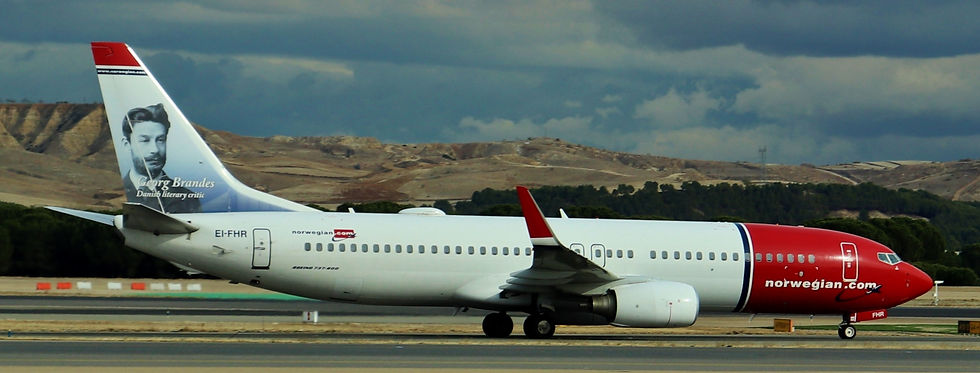
The Boeing 737-800 is the backbone of the fleet, flying all short and medium flights since 2008. (Photo:airplane-pictures.net) Norwegian launched its long-haul operation in May 2013. The long-haul flights operated by fully owned subsidiaries which are: Norway-based Norwegian Long Haul, Ireland-based Norwegian Air International, and United Kingdom-based Norwegian Air UK.
The first scheduled flights were from Oslo and Stockholm to New York JFK and Bangkok, originally with wet-leased A340-300 aircraft while the airline awaited delivery of the new Boeing 787 Dreamliner aircraft. In September 2013, Norwegian announced flights from Stockholm to Oakland and Los Angeles beginning in May 2014, from Copenhagen to Los Angeles and New York, and from Oslo to Oakland, Los Angeles and Orlando. The first of the new Boeing 787-8 Dreamliners were delivered during the Summer of 2013.

Norwegian Long Haul started operations in May 2013 with leased Airbus A340-300. (Photo:fotoverden.no) 
The first new Boeing 787-8 for Norwegian arrived in the Summer of 2013. (Photo:planespotters.net) In 2016 Norwegian won its first charter contract in the United States, flying three Boeing 737-800s to Mexico and the Caribbean from December 2016 to April 2017. In July 2016, the airline launched flights from Paris Charles de Gaulle to New York, Los Angeles and Fort Lauderdale. Also in July 2016, the airline confirmed it would select the Airbus A321LR (long Range) for it future medium haul flights, to be delivered from 2019.
In September 2016, the airline announced flights from Barcelona to Los Angeles, Oakland and Newark in June 2017, and Fort Lauderdale in August 2017. On 20 April 2017, Norwegian announced its second long-haul destination in Asia with flights between London's Gatwick and Singapore using Boeing 787s operated by Norwegian Air UK. On 29 June 2017, Norwegian received its first Boeing 737 MAX.

In June 2017, the new generation Boeing 737-8 Max aircraft entered service with Norwegian. (Photo:airplane-pictures.net) Norwegian Air Argentina was established on 25 January 2017 and started operating domestic services in Argentina with Boeing 737-800 from September 2018. Also, in June 2017, the airline announced flights from London to Buenos Aires, to begin in February 2018.
During 2018, the airline continued to expand dramatically inaugurating new long haul routes from bases across Europe (Madrid, Rome, Paris, Milan, London) to destinations in Asia, North America and South America.
To finance its aggressive growth involving the inauguration of many new routes, the hiring and training of new employees, and the accepting of aircraft deliveries, Norwegian sold some of its shares. Norwegian changed its strategy from growth to profitability in 2018, and in January 2019, the airline announced restructuring measures consisting of the closure of several crew bases mostly for its Boeing 737 operations outside Norway and the cancellation of nearly its entire Airbus order. On 11 July 2019, the company's founder Bjørn Kjos stepped down as CEO.
On 12 March 2019, the group had grounded all of its Boeing 737 MAX aircraft, after the grounding of the type by EASA, in the wake of the Ethiopian Airlines and Lion Air crash.
Throughout 2019, adding to its problems, Norwegian faced mounting debt due to rapid fleet expansion, operational challenges with aircraft engines, and the global grounding of the Boeing 737 MAX. During that year, Norwegian undertook route rationalisation, cutting unprofitable services and shifting operations—for example, consolidating transatlantic routes in major hubs such as San Francisco and New York JFK while discontinuing others like Newark. It also planned new seasonal long-haul routes between Europe and North America, including Paris–Chicago and Rome–Denver, reflecting its continued belief—at least at that stage—in the viability of long-haul low-cost operations.
Despite these efforts, 2019 exposed the fragility of Norwegian’s business model. Financial pressures forced the airline to sell aircraft, reduce capacity, and seek creditor support to avoid insolvency. This precarious position set the stage for the events that would unfold in 2020. Norwegian Air Argentina ceased operations in March 2020. The airline sold its Argentine subsidiary to low-cost competitor JetSmart in December 2019.

Due to financial debts Norwegian Air Argentina ceased operations in March 2020. The airline sold its Argentine subsidiary to low-cost competitor JetSmart. (Photo: airliners.net) The year 2020 marked a turning point as the COVID-19 pandemic devastated global aviation. Norwegian’s long-haul network was effectively shut down, with its Boeing 787 fleet grounded and operations suspended. The airline postponed long-haul flights entirely and cancelled outstanding aircraft orders, including Dreamliners that had not yet been delivered. At the same time, the company undertook drastic financial restructuring measures, converting approximately €1.2 billion in debt into equity and renegotiating aircraft leasing agreements under “power-by-the-hour” arrangements, meaning it paid only for aircraft usage. These emergency measures reflected a shift from expansion to survival, as the airline sought to conserve liquidity amid unprecedented demand collapse.
In 2021, Norwegian executed a comprehensive restructuring that fundamentally reshaped the company. Early in the year, it formally abandoned its long-haul strategy, announcing the permanent discontinuation of transatlantic and intercontinental operations. The airline also cancelled large aircraft orders, including Airbus A320neo and A321LR jets, and began returning or terminating leases for many aircraft, particularly wide-body jets. The company filed for bankruptcy protection processes in multiple jurisdictions, including under Irish examinership and U.S. Chapter 15, while simultaneously pursuing a reconstruction under Norwegian law.
By May 2021, Norwegian’s restructuring plan had been approved and implemented, significantly reducing its debt burden and simplifying its corporate structure. The airline emerged as a much smaller entity focused exclusively on short-haul European and Nordic routes, with a standardized fleet primarily composed of Boeing 737 aircraft. Bases outside its core markets—including in the United Kingdom, Spain, and the United States—were closed, and thousands of jobs were eliminated. This marked the end of Norwegian’s identity as a global low-cost long-haul disruptor and the beginning of a more conservative, regionally focused business model.
In 2022 and 2023, Norwegian entered a recovery phase. The airline rebuilt its network across Europe, gradually increasing capacity as travel demand returned following the pandemic. It operated a fleet of narrow-body aircraft and expanded to dozens of destinations across the continent. By 2023, the airline reported its strongest operating profit in its history, signalling a successful turnaround after the restructuring.
During this period, Norwegian also began to rebuild its market presence through partnerships and group expansion. A notable development was the acquisition of regional airline Widerøe (mentioned in industry analysis), which strengthened its domestic and regional connectivity within Scandinavia and supported feeder traffic into its broader European network. The airline’s route network expanded to approximately 150 destinations, primarily within Europe, reflecting a disciplined but steady growth strategy.

Norwegian completed its acquisition of Widerøe in January 2024, creating a combined entity to strengthen competition in Norway. (Photo: Planespotters.net) From 2024 to 2026, Norwegian continued consolidating its position as a profitable short-haul carrier. Financial performance improved significantly, with strong earnings and profitability returning after years of losses. The airline also resumed shareholder returns, including dividend announcements in 2025. During this time, the Norwegian government exited its ownership stake, which had been acquired as part of the 2021 restructuring support.
The airline gradually reintroduced the Boeing 737-8MAX into its long-term planning after initially distancing itself from the type during the crisis.

The airline gradually reintroduced the Boeing 737-8MAX into its long-term planning after recovering from its 2020 crisis and from 2023 has added more airframes. (Photo: Planespotters.net) Looking toward the future, Norwegian has placed significant orders for Boeing 737 MAX 8 aircraft, including an initial agreement for 50 aircraft in 2022 and an additional order for 30 more in 2025. Rather than returning to long-haul operations, Norwegian’s future route development is expected to focus on increasing frequencies on key European city pairs.
Airline Factual Information
Norwegian Air Shuttle serves destinations throughout Europe and North Africa for both business and leisure markets. Combined with its integrated subsidiaries that operate additional short-haul flights, the airline flies to 104 destinations as of January 2021.
The busiest routes in Norwegian's network are the Oslo to Bergen and the Oslo to Trondheim routes with 15 daily round-trips. Norwegian's largest non-Scandinavian operation is to London Gatwick with up to 24 daily round-trips. Intra-Scandinavian routes, and in particular on "the capital triangle" between Oslo, Stockholm and Copenhagen, are attractive due to extensive traffic for both business and leisure travellers.
It's the only airline which offers its passengers free WIFI on board, and gives a unlimited content during the flight.
Norwegian flies to the following destinations*:
Region 🗺️
Destinations 🌍🌎🌏
Domestic
• Norway: Ålesund, Alta, Andenes, Bardufoss, Bergen, Bodø, Harstad/Narvik, Haugesund, Kirkenes, Kristiansand, Lakselv, Longyearbyen, Molde, Oslo, Sandefjord, Stavanger, Tromsø, Trondheim
Nordics
• Denmark: Aalborg, Aarhus, Billund, Copenhagen, Rønne • Finland: Helsinki, Kittilä, Rovaniemi • Iceland: Reykjavík • Sweden: Gothenburg, Kiruna, Luleå, Skellefteå, Stockholm, Umeå, Visby
Europe
• Albania: Tirana • Austria: Vienna, Salzburg • Belgium: Brussels • Bosnia and Herzegovina: Sarajevo • Bulgaria: Burgas, Sofia, Varna • Croatia: Dubrovnik, Pula, Split, Zadar, Zagreb • Cyprus: Larnaca • Czech Republic: Prague • Estonia: Tallinn • France: Ajaccio, Bastia, Bordeaux, Lyon, Montpellier, Nice, Paris • Germany: Berlin, Düsseldorf, Hamburg, Munich • Greece: Athens, Chania, Corfu, Heraklion, Kos, Rhodes, Santorini, Thessaloniki • Hungary: Budapest • Ireland: Dublin • Italy: Bari, Bergamo, Bologna, Catania, Milan, Naples, Olbia, Palermo, Pisa, Rome, Venice, Verona • Kosovo: Pristina • Latvia: Riga • Lithuania: Palanga, Vilnius • Malta: Luqa • Montenegro: Tivat • Netherlands: Amsterdam • North Macedonia: Skopje • Poland: Gdańsk, Kraków, Poznań, Szczecin, Warsaw • Portugal: Faro, Funchal, Lisbon, Porto • Romania: Bucharest • Serbia: Belgrade • Slovenia: Ljubljana • Spain: Alicante, Barcelona, Bilbao, Ibiza, Lanzarote, Las Palmas, Madrid, Málaga, Menorca, Palma de Mallorca, Tenerife, Valencia • Switzerland: Basel, Geneva • United Kingdom: Edinburgh, London, Manchester, Newcastle
Middle East & Africa
• Egypt: Hurghada, Giza, Sharm El Sheikh • Israel: Tel Aviv • Lebanon: Beirut • Morocco: Agadir, Marrakesh • Turkey: Antalya, Bodrum, Gazipaşa, Istanbul
Updated April 2026
The airline centres its operations around the Boeing B737-800 and new Boeing B737-8Max aircraft, which it operates 94 units as of 2026. Having overcome a financial crisis with the pandemic back in 2020 when it operated other Boeing long haul planes and major subsidiaries in other parts of the world, the company now looks much brighter and is only operating with one type to prioritise its service and range around the short and medium haul sectors.
The fleet* of Norwegian Air Shuttle consists of the following aircraft:
Aircraft Type
In Service
On Order
Configuration (F, C, P, Y)
Boeing 737-800
51
—
(Y) 3-3
Boeing 737 MAX 8
35
79
(Y) 3-3
Updated April 2026
(Configuration: C = Business Class, P = Premium Economy , Y = Economy)


Reviews and comments ⭐
What Stands Out 😀👍 | Needs Improvement 🫤👎 |
✅ Passengers frequently praise the modern and well-maintained fleet, particularly noting the cleanliness of the Boeing 737 aircraft. | 👎 The customer service response time is often cited as slow, especially when dealing with flight disruptions, cancellations, or refund requests. |
✅ The airline is often recognized for its competitive pricing, offering some of the most affordable fares across the European short-haul network. | 👎 There is frequent dissatisfaction regarding the high cumulative cost of "hidden" fees for essentials like cabin bags, checked luggage, and seat selection. |
✅ The complimentary high-speed Wi-Fi provided on most flights is a standout feature that passengers find superior to many other low-cost carriers. | 👎 Seat comfort and legroom are described as tight, which can make longer flights within the network feel cramped for taller passengers. |
✅ Ground staff and cabin crew are generally described as professional, friendly, and efficient during the boarding process and in-flight service. | 👎 Frequent travellers have noted occasional issues with the reliability of the mobile app and website during the check-in process. |
✅ The "LowFare" calendar and user-friendly booking interface make it easy for travellers to find the cheapest travel dates at a glance. | 👎 Passengers have reported frustration with the lack of complimentary refreshments, as even water often requires a purchase on board. |
*Reviews are collected from independent sites and compelled by the most representative reviews and comments. Planet Airlines Ltd remains impartial to any airlines.