

Airline Chronological History
The airline was established on 29 December 1928 by the Polish government as a self-governing limited liability corporation, taking over existing domestic airlines Aerolot (founded in 1922) and Aero (founded in 1925), and started operations on 1 January 1929. The first routes were from Warsaw to Kraków, Poznań, Gdańsk and Lwów. The first aircraft used were Junkers F.13 and Fokker F.VII.

The first routes flown by the early airline were from Warsaw to Kraków, Poznań, Gdańsk and Lwów with Junkers F.13. (Photo:aeroklub.nowytarg.pl) Its first international service began on 2 August 1929 to Vienna. It was also at this point in time that LOT's well-renowned logo (still in use today) was picked as the winning entry of the airline's logo design competition. LOT was accepted into IATA in 1930.
In 1931 the stork and Gronowski's logo were officially recognised by the company's corporate leadership as the emblem of LOT Polish Airlines, and in the same year the company's first multi-segment international flight along the route Warsaw - Lwów - Czerniowce – Bucharest was launched. In next years followed services to Berlin, Athens, Helsinki and Budapest. In 1939 the lines were extended to Beirut, Rome, Copenhagen, reaching 10,250 km of routes. Douglas DC-2, Lockheed Model 10A Electra and Model 14H Super Electra joined the fleet in 1935, 1936 and 1938 respectively.. Several Polish aircraft designs were tested, but only single engined PWS-24 airliner was acquired in any number.

The Douglas DC-2 joined in 1935, it helped open up new international routes in Europe. (Photo: Wikimedia.org) 
Also Lockheed 10A Electra, joined in 1936 to support the new routes. (Photo:pprune.org) In 1934, after five years of operating under the LOT name, the airline received new head offices, technical facilities, hangars, workshops and warehouses located at the new, modern Warsaw Okęcie Airport. This constituted a move from the airline's previous base at Pole Mokotowskie as this airport had become impossible to operate safely due to the way in which it had gradually become absorbed into Warsaw's outlying urban and residential areas.
In 1938 LOT changed its name, in accordance with the Polish spelling reform of that year from Polskie Linje Lotnicze 'LOT' to Polskie Linie Lotnicze 'LOT'. There were plans to open services among others to London and Moscow and even transatlantic service in 1940. Services were suspended after an outbreak of the Second World War on 1 September 1939 and during following German occupation; most of LOT's aircraft were evacuated to Romania, two to Baltic states, and three L-14H to Great Britain. Thirteen airliners, that got to Romania, were next seized by Romanian government.
After a liberation of Poland, from August 1944 until December 1945 the Polish Air Force maintained basic transport in the country. On 10 March 1945 the Polish government recreated the LOT airline, as a state-owned enterprise .
In 1946, seven years after the service was suspended, the airline restarted its operations after receiving ten Soviet-built ex-Air Force Lisunov Li-2Ts, then further passenger Li-2Ps and nine Douglas C-47s. Both domestic and international services restarted that year, first to Berlin, Paris, Stockholm and Prague.

After the war, in 1946, LOT restarted operations with some Douglas c-47 (DC-3). (Photo:Airliners.net) In 1947 it added routes to Bucharest, Budapest, Belgrade and Copenhagen. Five modern, although troublesome SE.161 Languedoc joined the fleet for a short period in 1947–1948, followed by five Ilyushin Il-12B in 1949; 13-20 Ilyushin Il-14s then followed in 1955–1957.

Ilyushin Il-12B joined in 1949. (Photo: Airliners.net) After the end of Stalinism in Poland, few Western aircraft would be acquired; five Convair 240s in 1957 and three Vickers Viscounts in 1962 proved to be the last until the 1990s. After that, the composition of the airline's fleet shifted exclusively to Soviet-produced aircraft, like the Tupolev Tu-134. Only in 1955 LOT inaugurated services to Moscow, being the centre of the Marxist–Leninist world, and to Vienna. Services to London and Zürich were not re-established until 1958, and to Rome until 1960.

After the end of Stalinism in Poland, it was allowed to purchase more western type aircraft like this Convair 240. (Photo:airliners.net) Nine Ilyushin Il-18 turboprop airliners were introduced in June 1961, leading to the establishment of routes to Africa and Middle East, and in 1963 LOT expanded its routes to serve Cairo. In the 1970s flights to Baghdad, Beirut, Benghazi, Damascus and Tunis were started. The Antonov An-24 was delivered from April 1966, followed by the first jet airliners Tupolev Tu-134 in November 1968 which were operated on European routes. The Ilyushin Il-62 long range jet airliner inaugurate the first transatlantic routes in the history of Polish air transport to Toronto in 1972 as a charter flight and a regular flight to New York City in 1973. LOT began service on its first Far East destination – Bangkok via Dubai and Bombay in 1977.

The first jet airliners, Tupolev Tu-134, were introduced in 1968. (Photo:airlinersnow.com) 
For long haul operations it used the Ilyushin Il-62 in 1972. (Photo:wikipedia.org) In 1977, the airline's introduced a revised livery (despite occasional changes, notably in corporate typography) with the large 'LOT' inscription in blue on the front fuselage, and a blue tail plane was introduced, with the original 1929 designed logo, despite many changes in livery, it was kept through the years, and to this day remains the same. In the Autumn of 1981, commercial air traffic in Poland neared collapse in the wake of the communist government's crackdown on dissenters in the country after the rise of the banned 'trade union' dissident Solidarity movement. Charter flights to New York and Chicago resumed only in 1984, and eventually regular flight connections were restored on 28 April 1985. Tupolev Tu-154 mid-range airliners were acquired, after the withdrawal of Il-18 and Tu-134 aircraft from LOT's fleet in the 1980s, and were deployed successively on most European and Middle East routes. In 1986 transatlantic charter flights also reached Detroit and Los Angeles.

In the 1980's, as Poland was taken over by Communism, the use of soviet planes was common, the Tu-154 was operated from 1985. (Photo:jetphotos.com) After the fall of the communist system in Poland in 1989 the fleet shifted back to Western aircraft, beginning with acquisitions of the Boeing 767-200 in April 1989, followed by Boeing 767-300 in March 1990, ATR 72 in August 1991, Boeing 737-500 in December 1992 and finally the Boeing 737-400 in April 1993. LOT was among the first Central European countries to operate American aircraft when the Boeing 767 was introduced; the 767s were used to operate LOT's longestever connection to Singapore.

After the fall of the Soviet imposition in Poland, Boeing 767-200 were operated for long haul flights. (Photo:wikimedia.org) 
For short haul flights it flew with the Boeing 737-500 from 1992. (Photo:jetphotos.com) In 1990 ATR 72 aircraft were acquired for use on LOT's expanded route network, which began to include new international destinations such as Kiev, Lviv, Minsk and Vilnius. Soon thereafter, in 1993, LOT began to expand its Western-European operations, inaugurating, in quick succession, flights to Oslo, Frankfurt and Düsseldorf, operations at Poland's other regional airports outside Warsaw were also duly expanded around this time.
By December 1992 the airline became a joint stock company, as a transitional step towards partial privatisation, which was effected in late 1999. After years of planning, in 1997 LOT set up a sister airline, EuroLOT, which, essentially operating as its parent airline's regional subsidiary, took over domestic flights. The airline was developed with the hope that it would increase transit passenger-flow through Warsaw's Chopin Airport, whilst at the same time providing capacity on routes with smaller load factors and play a part in developing LOT's reputation as the largest transit airline in Central and Eastern Europe. By 1999 LOT had purchased a number of small Embraer 145 regional jets in order to expand its short-haul fleet.

In 1997, it created its subsidiary airline, EuroLot for regional operations. (Photo:flickriver.com) Expansion of LOT's route network continued in the early 2000s and the potential of the airline's hub at Warsaw Chopin Airport to become a major transit airport was realised with more and more success. In 2000 LOT took delivery of its largest ever order of 11 aircraft. On 26 October 2003, LOT, became the 14th member of the Star Alliance. By 2006 a new base of operations, with the reconstruction of Warsaw Chopin Airport, had opened, thus allowing LOT's full transit airline potential to be developed for the first time ever.
In 2008 LOT opened a new flight to Beijing, however this lasted just a month, as LOT did not have permission for flights over Siberia from the Russian government, which was making the services too long and thus unprofitable. LOT started new services to Yerevan, Armenia, Beirut, Lebanon and resumed Tallinn, Estonia, Kaliningrad, Russia, Gothenburg, Sweden and Bratislava, Slovakia with its newly acquired Embraer aircraft in summer 2010, and in October of the same year LOT resumed service to Asia, with three weekly flights on the Warsaw-Hanoi route. In addition to this, new services to Tbilisi, Damascus and Cairo were inaugurated.
In 2010 LOT cancelled flights, after 14 years of operation, between Kraków and the US destinations of Chicago and New York, citing profitability concerns and lack of demand.

The Embraer E170 was introduced in 2010, to compete more effectively with lower demand, but still important routes over Europe. (Photo:Planespotters.net) On 31 May 2010, CEO of LOT stated that the airline will be replacing its fleet to meet a goal of one-third new by 2011. Replacement already started with Embraer E-Jets 175/170. For domestic expanded operations, LOT purchased Dash 8-Q400 over ATR 72-600 aircraft.
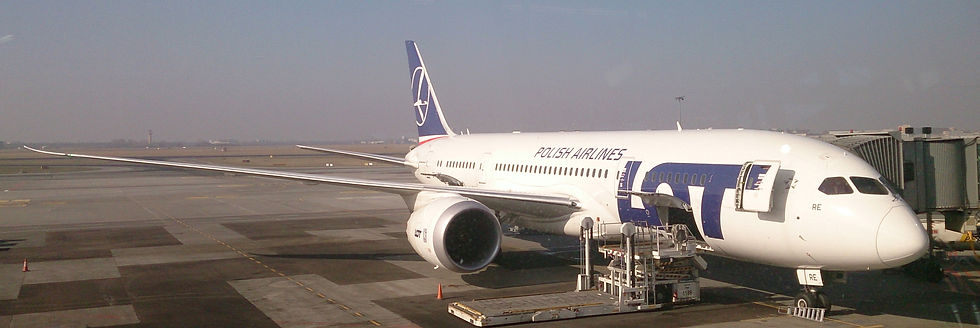
On 5 February 2011, new routes to Tokyo and Beijing were launched. This was now feasible since the finalizing of an agreement on Siberian overflight permits for LOT by the Polish and Russian governments in November 2011. On the 24th June 2011, LOT presents the world's most modern passenger airplane, Boeing 787 Dreamliner, joining the fleet. LOT took delivery of a total of six Boeing 787 Dreamliners, with the remaining two aircraft expected to join the fleet by 2017.

In June 2011, LOT took delivery of the first Dreamliner, B787-8 for the long haul expansion. (Photo:airliners.net) Although delayed from the original plans, LOT began flights to Tokyo Narita Airport in Japan on 13 January 2016, with flights three times per week. In 2010/11 LOT also announced in line with its new policy, LOT introduced, for the first time, a premium economy on all Boeing 787 aircraft. Additionally lie-flat seats are available in business class and all of the airline's new long-haul aircraft have been fitted with Thales personal entertainment systems.
In June 2012 LOT announced all services to New York would be centralized to JFK Terminal 1 from October 2012. During 2012, LOT said goodbye to the last Boeing 767 in the fleet.
Amidst a restructuring plan which saw the airline return to profitability for the first time in seven years, a 22 June 2015 press conference revealed details pertaining to the airlines future prospects. These include reinstating routes renounced as part of EU sanctions imposed following Polish government aid granted to ensure the airline's survival, as well as new long haul routes to Asia and North America. As well, the same year, on 6 February 2015, it was announced that EuroLot would be liquidated due to financial problems and end operations on 31 March 2015. LOT Polish Airlines assumed some of Eurolot's routes, re-leasing former Eurolot aircraft.
As part of the airlines future fleet expansion, Air Lease Corporation confirmed on October 13, 2016 the placement of 6 Boeing 737 MAX 8 aircraft with LOT, and options to lease 5 further aircraft of the same type. Long haul plans saw the addition of further Boeing 787 aircraft, increasing the total to 16 in the coming years.
LOT received the Boeing 737 Max8, which has helped retire older -400 models in 2016 but had to store them until 2020 when the type was recertified to fly again. (Photo: planepictures.net) Between 2016 and 2019, LOT experienced rapid network growth, particularly from its primary hub at Warsaw Chopin Airport. The airline expanded aggressively into long-haul markets, especially North America and Asia, leveraging the efficiency of its Boeing 787 Dreamliner fleet. During this period, LOT added destinations such as Los Angeles, Newark, and Tokyo, while also strengthening frequencies to established Polish diaspora markets like Chicago and Toronto. From 2018, LOT started to receive new leased Boeing 787-9 , the bigger variant which supplemented the existing B787-8. By 2019, LOT carried nearly 9 million passengers annually, a record at the time, reflecting the success of its hub-and-spoke model.

From 2018, LOT started to receive new Boeing 787-9, which were used on new routes to Los Angeles, Newark, and Tokyo. (Photo: planespotters.net) The outbreak of the COVID-19 pandemic in 2020 marked a major disruption. Like most global airlines, LOT was forced to suspend a large portion of its network and experienced a sharp drop in passenger numbers. However, the airline maintained strategic continuity by focusing on cargo operations, repatriation flights, and maintaining key routes where possible. LOT returned the Boeing 737-8 MAX to service on 31 December 2020, following the aircraft’s recertification by EASA (the European Union Aviation Safety Agency).
From 2021 onwards, LOT entered a recovery phase that gradually transitioned into renewed expansion. The airline resumed long-haul routes and restored connectivity across Europe and Asia. Notably, LOT became one of the early adopters of onboard wireless entertainment systems on its Boeing 737-8Max fleet.
By 2023–2024, LOT had regained growth momentum, supported by increasing passenger demand and the reopening of global travel markets. The fleet continued to evolve with the introduction of Embraer E195-E2 aircraft in from July 2024, which provided improved efficiency on regional routes and complemented the airline’s existing Embraer fleet.
The fleet continued to evolve with the introduction of Embraer E195-E2 aircraft from July 2024. (Photo: Jetphotos.com) The years 2025 and 2026 represent a new strategic phase characterized by large-scale fleet renewal and ambitious network expansion. In 2025, LOT reported a record operational year, carrying approximately 11.7 million passengers—an increase of nearly 10% compared to the previous year—and launching nine new destinations. These included routes such as Lisbon, Marrakesh, Thessaloniki, and others, reflecting a diversification of its European and leisure-oriented network.
In June 2025 LOT placed its first-ever order with Airbus, committing to 40 Airbus A220 aircraft (20 A220-100 and 20 A220-300), with options to expand the order significantly. This marked a historic shift in fleet strategy, as the airline had previously relied almost exclusively on Boeing and Embraer aircraft. The A220 is intended to replace aging Embraer jets and form the backbone of LOT’s regional operations from 2027 onward.
At the same time, LOT committed to a broader fleet expansion program involving a total of 55 new aircraft, with options for additional units. Deliveries of Boeing 737 MAX 8 aircraft accelerated, with 13 expected to enter service by mid-2026. On the long-haul side, the airline secured additional Boeing 787-8 Dreamliners.
In 2026, the airline is launching a new direct route from Warsaw to San Francisco, significantly strengthening its North American network, which already includes several major U.S. destinations. In parallel, LOT is expanding into Asia with the introduction of a year-round Warsaw–Bangkok service beginning in late 2026.
Another key aspect of LOT’s strategy is decentralization within Poland. The airline is increasingly developing secondary hubs, particularly in Kraków and Gdańsk, with new direct routes to major European cities such as Madrid, Barcelona, and Rome.
Its future trajectory suggests continued expansion, technological modernization, and an increasingly prominent role as a gateway between Europe and global markets.
Airline Factual Information
The national Polish airline counts with a good extensive network flying to 97 destinations across Europe, Asia and North America. Most of the destinations originate from its hub at Warsaw Chopin Airport, being its main hub, however, Krakow is also an important focus city, flying mostly domestic and European routes.
Lot has also expanded into other European countries and now offers direct services from a number of other bases, including Vilnius to London City Airport (LCY).
LOT Polish Airlines flies to the following destinations*:
Region 🗺️
Destinations 🌍🌎🌏
Domestic
• Poland: Bydgoszcz, Gdańsk, Katowice, Kraków, Lublin, Olsztyn, Poznań, Rzeszów, Szczecin, Warsaw, Wrocław, Zielona Góra
Africa
• Egypt: Cairo, Hurghada • Kenya: Mombasa • Morocco: Marrakesh
Americas
• Brazil: Rio de Janeiro, Salvador • Canada: Toronto • Cuba: Varadero • Dominican Republic: Puerto Plata, Punta Cana • Mexico: Cancún • United States: Chicago, Los Angeles, Miami, Newark, New York City, San Francisco
Asia
• Armenia: Yerevan • Azerbaijan: Baku • China: Beijing, Tianjin • India: Delhi, Goa, Mumbai • Indonesia: Denpasar • Japan: Tokyo • Kazakhstan: Almaty, Astana • Lebanon: Beirut • Saudi Arabia: Riyadh • South Korea: Seoul • Sri Lanka: Colombo • Thailand: Bangkok, Phuket • Uzbekistan: Tashkent • Vietnam: Phu Quoc
Europe
• Albania: Tirana • Austria: Vienna • Belgium: Brussels • Bosnia and Herzegovina: Sarajevo • Bulgaria: Sofia, Varna • Croatia: Dubrovnik, Pula, Rijeka, Split, Zadar, Zagreb • Cyprus: Larnaca • Czech Republic: Ostrava, Prague • Denmark: Billund, Copenhagen • Estonia: Tallinn • Finland: Rovaniemi • France: Lyon, Nice, Paris • Georgia: Tbilisi • Germany: Berlin, Düsseldorf, Frankfurt, Hamburg, Munich, Nuremberg, Stuttgart • Greece: Athens, Corfu, Kos, Mytilene, Rhodes, Thessaloniki • Hungary: Budapest • Iceland: Reykjavík • Ireland: Dublin • Israel: Tel Aviv • Italy: Bologna, Milan, Rimini, Rome, Venice • Latvia: Riga • Lithuania: Kaunas, Palanga, Vilnius • Luxembourg: Luxembourg City • Malta: Valletta • Moldova: Chișinău • Montenegro: Podgorica, Tivat • Netherlands: Amsterdam • North Macedonia: Ohrid, Skopje • Norway: Oslo, Stavanger • Portugal: Lisbon • Romania: Bucharest, Cluj-Napoca, Oradea • Serbia: Belgrade • Slovakia: Košice • Slovenia: Ljubljana • Spain: Barcelona, Madrid, Málaga, Palma de Mallorca, Tenerife • Sweden: Gothenburg, Stockholm • Switzerland: Geneva, Zurich • Turkey: Antalya, Istanbul • United Kingdom: London (LHR) (LCY)
Updated April 2026
Lot has completed its major fleet modernization programme and now operates a modern fleet of Boeing Aircraft for most of its destinations. It also uses the Embraer E170, E175, E190, E195 and E195-E2 for regional and domestic routes. However, these airframes will be replaced by new Airbus A220 from 2027. All of LOT's long haul flights are operated by the Boeing Dreamliners, B787-8 and B787-9
The airline operates the following fleet*:
Aircraft Type
In Service
On Order
Configuration (F, C, P, Y)
Embraer 170
5
0
(C) 2-2 / (Y) 2-2
Embraer 175
13
0
(C) 2-2 / (Y) 2-2
Embraer 190
8
0
(C) 2-2 / (Y) 2-2
Embraer 195
15
0
(C) 2-2 / (Y) 2-2
Embraer 195-E2
3
0
(C) 2-2 / (Y) 2-2
Airbus A220-100
0
20
(C) 2-3 / (Y) 2-3
Airbus A220-300
0
20
(C) 2-3 / (Y) 2-3
Boeing 737-800
6
0
(C) 3-3 / (Y) 3-3
Boeing 737 MAX 8
24
7
(C) 3-3 / (Y) 3-3
Boeing 787-8 Dreamliner
8
2
(C) 2-2-2 / (P) 2-3-2 / (Y) 3-3-3
Boeing 787-9 Dreamliner
7
0
(C) 2-2-2 / (P) 2-3-2 / (Y) 3-3-3
Updated April 2026
(Configuration: C = Business Class, P = Premium Economy , Y = Economy)


Reviews and comments ⭐
What Stands Out 😀👍 | Needs Improvement 🫤👎 |
✅ Regional Comfort: Passengers frequently praise the Embraer fleet for its 2-2 seating configuration, which eliminates the "middle seat" and provides a spacious feel. | 👎 Hard Seating: On newer Boeing aircraft, many travellers report that the seat cushions are notably firm and uncomfortable for long-haul journeys. |
✅ Unexpected Amenities: Travelers appreciate the complimentary traditional Polish snacks (like apple buns) and beverages even on shorter European routes. | 👎 Customer Service Loops: Frequent complaints highlight difficulties reaching human agents, with many getting stuck in frustrating automated or "chatbot" cycles. |
✅ Professional Crew: Many reviews highlight individual crew members who go above and beyond, specifically noting their calm handling of difficult in-flight situations. | 👎 Inconsistent Staff Attitude: While some crew are exceptional, others are described as "cold" or "robotic," leading to an inconsistent service experience. |
✅ Quality Catering: The quality of meals on long-haul flights is often cited as a high point, with many finding the food tastier than typical airline fare. | 👎 Special Meal Errors: There are recurring reports of the airline failing to provide the correct special meals (e.g., Vegetarian vs. Vegan) despite advance bookings. |
✅ Efficient Hub: Warsaw Chopin Airport is often noted as a relatively easy and quick hub for transfers compared to larger European counterparts. | 👎 Baggage & Tech Issues: Passengers have reported significant delays in baggage recovery and a lack of transparency regarding refund policies for cancelled flights. |
*Reviews are collected from independent sites and compelled by the most representative reviews and comments. Planet Airlines Ltd remains impartial to any airlines.