


Airline Chronological History
In September 1976 the Civil Aviation Company was formed from the merger of existing airlines Royal Air Lao and Lao Air Lines. The company became Lao Aviation in 1979. The national carrier initially started with a mixed fleet of Western aircraft, including the Douglas DC-3 and DC-4, operating on international and domestic routes, as well as a fleet of helicopters for more remote regions

The initial airline was formed from Lao Air Lines and Royal Air Lao in 1976 using their former planes. (DC-). (Photo:goodall.com.au) 
Royal Air Lao was also merged with Lao Air Lines to form the current airline. This DC-4 was inherited from Royal Air Lao. (Photo:goodall.com.au) Reflecting the country's closer links with its Eastern neighbours, a re-equipment exercise was undertaken in the 1980s, with the fleet then primarily composed of aircraft from China and the Soviet Union. For international services to Bangkok, Hanoi and Phnom Penh these included the Antonov An-24.
In 1994, the airline upgraded its fleet with ATR-42 turboprop aircraft and by 1995 had acquired an ATR-72 aircraft, adding Xian Y-7 and Harbin Y-12 aircraft to its fleet. A joint venture with China Yunnan Airlines and the Lao government was formed, which re-nationalized Lao Aviation in 2000.
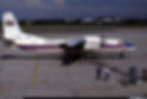
During the 1980's with the influence of China and Russia, the airline was nationalised and adquired soviet aircraft like the Antonov An-24. (Photo:airliners.net) 
Lao Aviation used ATR -42 and ATR-72 (pictured) from 1994 and 1995 respectively. (Photo:flickr.com) In 2003, the airline was re-branded to become Lao Airlines. At the same time, the airline continued to rely heavily on ATR turboprop aircraft, which were particularly suited to Laos’s short runways and geographically challenging domestic network. The introduction and expansion of ATR 72 aircraft from 2003 onward allowed Lao Airlines to maintain regular services between Vientiane and secondary cities such as Luang Prabang, Pakse, and Savannakhet, strengthening domestic connectivity.

In 2003, the airline rebranded as Lao Airlines, and changed its logo and brand colours. It also began to add ATR72-200 in July 2003 to supplement its fleet. (Photo: Planespotters.net) Throughout the mid-2000s, the airline focused on stabilising operations and gradually rebuilding its reputation, which had been affected by earlier safety concerns. As Laos opened up economically and tourism began to grow, Lao Airlines increased its regional presence, operating international routes to neighbouring countries including Thailand, Vietnam, Cambodia, and southern China.
A major milestone in the airline’s modernisation occurred in 2011 with the reintroduction of Airbus A320 aircraft into the fleet. On the 8 November 2011 it took delivery of the first of two Airbus A320 aircraft ordered from Airbus, the second A320 arriving in December 2011. The A320s are the first jet aircraft to be purchased by Lao Airlines and feature a two-class layout seating 126 passengers in the main cabin and 16 in Business Class and are powered by CFM International CFM56 engines. The Airbus A320 aircraft flew primarily on international services to Bangkok, Hanoi, Kunming, Guangzhou, Seoul and Busan.
Unlike the earlier short-term lease, this time the acquisition formed part of a long-term fleet strategy. The A320 provided Lao Airlines with a modern narrow-body jet capable of operating higher-capacity and longer-range regional routes.

The newest aircraft type, and biggest for Lao Airlines is the Airbus A320, delivered in November 2011. (Photo:airliners.net) At the same time, Lao Airlines continued to modernise its turboprop fleet. The introduction of the ATR 72-600 in 2012, represented a significant upgrade over earlier ATR variants, offering improved fuel efficiency, avionics, and passenger comfort.
This dual-fleet strategy—combining jets for regional international routes and turboprops for domestic and short-haul services—became a defining feature of the airline’s operational model.

In October 2012, Lao Airlines took delivery of newer turboprop ATR 72-600 to replace older soviet planes and improve it services.(Photo:Planespotters.net) The airline’s growth trajectory was not without challenges. Like many smaller national carriers, Lao Airlines faced constraints related to limited capital, infrastructure, and market size. Its fleet remained relatively small, and expansion was often incremental rather than rapid.
By the late 2010s, the airline had established a stable operational base, serving around 20 destinations across Southeast Asia and parts of East Asia, with hubs in Vientiane and Luang Prabang.
The COVID-19 pandemic in 2020–2022 had a significant impact on Lao Airlines, as it did across the global aviation industry. International travel restrictions led to a sharp reduction in passenger demand, forcing the airline to scale back operations and rely more heavily on domestic services. Recovery was gradual, but as regional travel resumed, Lao Airlines began rebuilding its network and restoring frequencies on key international routes.
A notable new phase in the airline’s development emerged in the mid-2020s with further fleet modernisation and technological diversification. In 2025, Lao Airlines took delivery of the COMAC C909 (formerly known as the ARJ21), becoming one of the first airlines outside China to operate this aircraft type. This move was significant both operationally and geopolitically. The C909, configured with around 90 seats, was deployed on domestic trunk routes such as Vientiane–Pakse and Vientiane–Savannakhet, replacing turboprops and increasing capacity while reducing travel times.

In March 2025, Lao Airlines took delivery of the COMAC C909, becoming one of the first airlines outside China to operate this aircraft type. (Photo: Planespotters.net) By 2025, Lao Airlines operated a fleet of approximately 13 aircraft, including Airbus A320s for regional jet services, ATR 72 variants for domestic operations, and the newly introduced COMAC C909 jets.
This fleet composition reflects a pragmatic approach to balancing capacity, cost efficiency, and route flexibility in a relatively small but geographically complex market. During this period, it was confirmed that the C909 served as an "interim type" while the airline prepared for the delivery of two larger C919 aircraft as part of its fleet modernization and international expansion strategy.
In terms of route development, the airline has continued to focus on strengthening links between Laos and key regional economic centres. Its network includes destinations in Thailand, Vietnam, Cambodia, China, and South Korea, with domestic routes remaining a critical component due to the country’s limited ground transport infrastructure.
The gradual enhancement of domestic trunk routes using jet aircraft in the 2020s indicates a shift toward higher-capacity, more efficient operations as demand grows.
Looking toward the present day, Lao Airlines remains a relatively small but strategically important carrier within Southeast Asia. Its development has been characterised not by rapid expansion, but by steady modernisation, cautious network growth, and incremental improvements in fleet and service quality. The airline’s future trajectory is likely to depend on continued economic development in Laos, regional tourism flows, and its ability to maintain a modern and efficient fleet while expanding connectivity in an increasingly competitive ASEAN aviation market.
Airline Factual Information
Lao Airlines is the national airline of Laos, with its main hub in Vientiane, the capital, and also has a strong presence in Luang Prabang, the second main city. It operates domestic as well as international services to countries such as Cambodia, China, Thailand, Vietnam, and Korea. It has plans to further expand operations as tourism to the region increases and the infrastructure of the country develops. It currently serves 21 destinations including domestic flights. It biggest market being China and Thailand.
The airline flies to the following destinations*:
Region 🗺️
Destinations 🌍🌎🌏
Domestic
• Laos: Vientiane, Luang Prabang, Pakse, Savannakhet, Luang Namtha, Oudomxay, Phongsaly, Xieng Khouang
East Asia
• China: Guangzhou, Kunming, Jinghong, Changsha, Chengdu, Changzhou, Shanghai, Wenzhou • South Korea: Seoul
Southeast Asia
• Cambodia: Phnom Penh, Siem Reap • Thailand: Bangkok, Chiang Mai • Vietnam: Hanoi, Ho Chi Minh City, Da Nang
Updated April 2026
The Airline has now a more modern fleet after completing a fleet renewal programme in the last few years. It now flies it's domestic and regional flights with Turboprop ATR-500/600 and new C909, manufuctured in China. The rest of short and medium routes operated internationally are operated with Airbus A320 aircraft.
The fleet* of Lao Airlines comprises the following aircraft:
Aircraft Type
In Service
On Order
Configuration (F, C, P, Y)
ATR 72-500
4
0
(Y) 2-2
ATR 72-600
3
0
(Y) 2-2
Comac C909
2
0
(C) 2-2 / (Y) 2-3
Comac C919
0
2
(C) 2-2 / (Y) 3-3
Airbus A320-200
4
0
(C) 2-2 / (Y) 3-3
Updated April 2026
(Configuration: C = Business Class, P = Premium Economy , Y = Economy)


Reviews and comments ⭐
What Stands Out 😀👍 | Needs Improvement 🫤👎 |
✅ Exceptional Staff: Cabin crews are frequently praised for being professional, polite, and welcoming, often providing the traditional "Sabaidee" greeting with a warm smile. | 👎 Aircraft Age: Many passengers noted that the interiors, particularly on the Airbus A320s and older ATRs, feel dilapidated, worn, or poorly maintained. |
✅ Reliable Punctuality: The airline has a strong reputation for on-time departures, with several instances of flights even arriving earlier than scheduled. | 👎 Cramped Seating: Taller travellers often report a very limited seat pitch on the smaller turboprop aircraft, making for a physically uncomfortable journey. |
✅ Generous In-flight Service: Despite very short flight times (sometimes under 45 minutes), passengers are surprised to receive complimentary water, snacks, or light meals. | 👎 Broken Technology: While many aircraft are equipped with in-flight entertainment screens, reviews consistently mention they are inactive or non-functional. |
✅ Efficient Ground Experience: Check-in processes and security at major hubs like Vientiane and Luang Prabang are typically described as fast and hassle-free. | 👎 Price and Value: Due to limited competition on many domestic and regional routes, many travellers feel the ticket prices are disproportionately high. |
✅ Clean Cabin Environment: Regardless of the age of the planes, travellers often highlight that the cabins are kept spotlessly clean and tidy. | 👎 Noisy Cabins: Passengers unfamiliar with propeller aircraft frequently find the ATR fleet to be significantly noisier than standard jet engines. |
*Reviews are collected from independent sites and compelled by the most representative reviews and comments. Planet Airlines Ltd remains impartial to any airlines.