

Airline Chronological History
Korean Air, (주식회사 대한항공) is the flag carrier of South Korea and its largest airline based on fleet size, international destinations, and international flights in the country. It is owned by the Hanjin Group. Korean Air is a founding member of SkyTeam alliance and SkyTeam Cargo.
Korean Air can trace its history to March 1, 1969, when the Hanjin group acquired government-owned Korean Air Lines, which had operated since June 1962. Korean National Airlines was the original name of the airline in its inception, which was founded in 1946, and changed its name to Korean Air Lines to become a state-owned airline.
To understand what Korean Air has become today, we need to travel back in time to the origins of Korean National Airlines (KNA), the first commercial airline established in Korea, which can be traced back to the immediate aftermath of the Second World War and the liberation of Korea from Japanese rule in August 1945. During the period of Japanese occupation, all aviation activities on the Korean Peninsula had been controlled by Japanese authorities, and there was no independent Korean civil aviation sector. With liberation, a small but ambitious group of Korean entrepreneurs and aviation enthusiasts recognized the importance of establishing a national airline to support economic recovery, improve communications, and symbolise sovereignty. This vision materialised in 1946 with the founding of Korean National Airlines, often abbreviated as KNA, making it the first airline established in Korea.
KNA was formally established in 1946, the early years were characterised by limited infrastructure, scarce financial resources, and a lack of trained aviation personnel. Airports in Korea had been heavily damaged during the war years, and maintenance facilities were minimal. The airline’s first aircraft acquisitions reflected both the constraints and opportunities of the post-war environment. KNA initially operated small, piston-engine aircraft, including Stinson L-5 Sentinels, which were surplus military liaison aircraft adapted for civilian use. As the airline sought to expand its operations, it gradually acquired slightly larger aircraft, including Douglas DC-3s.

Early aircraft, included those used by the US Military, like this Stinson L-5 wearing US Air Force markings most likely taken over Korea during the Korean War where the aircraft performed liaison missions and air-ambulance missions. (Photo: dvidshub.net) 
When Korean National Airlines was established in 1946, the DC-3 was one of the first to offer regular passenger flights. (Photo: aeroweb.cz) By 1948, as the Republic of Korea was formally established in the South, KNA began operating more regular domestic services, linking key cities such as Seoul and Busan. These routes were vital in facilitating administrative coordination and economic exchange in a country still rebuilding from decades of colonial rule.
In 1949, KNA achieved a significant milestone by launching its first international route, connecting Seoul with Hong Kong.
However, the outbreak of the Korean War in June 1950 had a devastating impact on the airline and the broader aviation sector. Civil aviation operations were largely suspended as the peninsula became a battlefield. During the war years, from 1950 to 1953, KNA ceased most of its commercial activities, and the survival of the airline itself was uncertain.
Following the armistice in 1953, efforts to rebuild South Korea extended to the aviation sector. KNA resumed operations in a country that had suffered immense physical and economic destruction. The Douglas DC-3 once again played a central role in the revival of operations, as it was widely available and well-suited to the conditions in Korea.
Throughout the mid-1950s, KNA focused on re-establishing its domestic network, reconnecting Seoul with major cities such as Busan, Daegu, and Gwangju. By the late 1950s, KNA had established itself as a symbol of national progress, despite its modest scale. It represented South Korea’s determination to rebuild and modernise in the face of adversity.
The early 1960s marked a turning point for Korean civil aviation. In 1961, a military coup led by Park Chung-hee brought significant political and economic changes to South Korea. The new government placed a strong emphasis on economic development and modernisation, including improvements to transportation infrastructure. Within this context, it became clear that KNA, in its existing form, was not capable of meeting the country’s growing aviation needs.
In 1962, the South Korean government decided to take decisive action by nationalising Korean National Airlines. The airline was reorganised and re-established as Korean Air Lines (KAL), marking the end of KNA as an independent entity. Under government ownership, the new airline would receive greater financial support, access to modern aircraft, and a clearer strategic direction. The newly formed airline inherited a small and aging fleet, consisting primarily of piston-engine aircraft such as the Douglas DC-3 and DC-4, which were used to maintain essential domestic air links between Seoul, Busan, and a handful of regional cities.

In 1962, the government nationalised Korean National Airlines. It was reorganised and re-established as Korean Air Lines (KAL) and inherited the aircraft types operated by its predecessor (KNA), like this DC-4. (Photo: Wikipedia.com) Throughout the 1960s, the airline began laying the groundwork for modernization. By 1963, it introduced more capable turboprop aircraft, including the Fokker F27-200 Friendship, which allowed for improved reliability and efficiency on domestic and short-haul regional routes. This period also saw incremental expansion with the airline flying to Hong Kong and Taipei as early international points, reflecting both economic ties and the growing importance of regional connectivity.
On 1 March 1969, the Hanjin Group acquired the state-owned airline and it is the beginning of the Korean Air we know today. This transition marked the beginning of a new era of rapid development and strategic ambition. Under Hanjin’s leadership, the airline underwent significant restructuring, with a focus on financial discipline, fleet modernization, and international expansion. The company also began to rebrand itself more assertively, eventually adopting the name “Korean Air”.
Korean Air's introduction of the Lockheed L-1049H Super Constellation into its fleet in 1969, was a period marked by rapid modernization following the airline’s re-establishment under the Hanjin Group. The L-1049H Super Constellation, a stretched and more capable variant of the iconic “Connie,” represented a major technological and operational upgrade for the airline.
The first DC-9-32 was delivered on 27 July 1969, just months after Korean Air Lines (as it was then known) was re-established under Hanjin Group ownership. The DC-9-32 configured in a single-class layout, provided a modern and efficient alternative to the airline’s earlier turboprop fleet. The DC-9-32 was primarily deployed on key domestic routes such as Seoul–Busan and Seoul–Jeju.

By 1963, Korean Air Lines introduced more capable turboprop aircraft, including the Fokker F27-200 Friendship (Photo: jjpostcards.com) 
Korean Air's introduction of the Lockheed L-1049H Super Constellation into its fleet in 1969 brought improved range and more destinations. (Photo: zoggavia.com) 
In 1969, the DC-9-32 was primarily deployed on key domestic routes such as Seoul–Busan and Seoul–Jeju. (Photo: en.namu.wiki) Korean Air Lines marked a significant milestone in its early jet age development with the introduction of the Boeing 720 into its fleet in June 1969. The aircraft become one of the airline’s first jet-powered types and signalling a transition away from piston-engine aircraft. Configured to carry approximately 140 passengers, the aircraft enabled the airline to enhance connectivity between South Korea and key destinations across East and Southeast Asia, including Japan, Hong Kong, and Taiwan.

Korean Air Lines introduced the Boeing 720 into its fleet in June 1969, one of the first jet aircraft to join the airline. This aircraft made regular visits to Taipei Songshan Airport pictured. (Photo: henrytenby.com) The early 1970s were characterized by bold investments in jet aircraft, signalling Korean Air’s entry into the modern aviation age. In 1971, the airline took delivery of the improved Boeing 707-320B, which represented a major technological leap forward. It was deployed on the Seoul–Tokyo route, reflecting strong business and cultural ties between South Korea and Japan.
Korean Air Lines took delivery of its first DC-8-62 on March 27, 1973, becoming one of the first carriers in East Asia to operate a long-range narrow-body jet capable of intercontinental service. The arrival of the DC-8 allowed Korean Air to significantly expand its international network beyond regional destinations. Shortly after the aircraft entered service, the airline launched new long-haul routes, including services from Seoul to Los Angeles.

In 1971, the Boeing 707-320B joined Korean Air Lines, which represented a major technological leap. It was deployed on the Seoul–Tokyo route. (Photo: airlinegeeks.com) 
Korean Air Lines took delivery of its first DC-8-62 on March 27, 1973. (Photo: airliners.net) The acquisition of additional Boeing 707 aircraft, followed by wide-body jets such as the Boeing 747-200 in 1973, enabled the airline to increase capacity and improve passenger comfort on long-haul flights. The introduction of the Boeing 747 was particularly significant, as it positioned Korean Air among a select group of airlines capable of operating high-capacity, long-distance services. This allowed the airline to strengthen its presence on transpacific routes, including flights to the United States.

The introduction of the Boeing 747-200 in 1973 was particularly significant, as it opened up markets operating high-capacity, long-distance services. (Photo: airliners.net) Route expansion during the 1970s was both ambitious and strategic. Korean Air extended its network across Asia, serving cities such as Bangkok, Manila, and Singapore. This was also possible thanks to the introduction of the Boeing 727-100 on regional routes to Asia in 1972. The airline established a foothold in Europe with services to cities like Paris.
Korean Air formally introduced the McDonnell Douglas DC-10 into its fleet in 1976, becoming one of the early Asian operators of the tri-jet long-haul aircraft. The arrival of the DC-10 enabled Korean Air to expand its intercontinental network on routes to North America, Europe, and the Middle East, the DC-10 quickly became a cornerstone of the airline’s long-haul operations throughout the late 1970s and 1980s.
The late 1970s also saw Korean Air refining its corporate identity and service standards. The airline invested in staff training, in-flight service enhancements, and marketing efforts aimed at elevating its international profile.

Korean Air Lines introduced the Boeing 727-100 on regional routes to Asia in 1972. (Photo: airliners.net) 
The arrival of the DC-10 in 1976, enabled Korean Air to expand intercontinental routes to North America, Europe, and the Middle East. (Photo: planespotters.net) By the early 1980s, Korean Air had firmly established itself as a major international carrier. Its fleet now included a mix of narrow-body and wide-body jet aircraft, allowing it to operate a diverse network of routes.
Throughout the early 1980s, Korean Air steadily added new destinations and frequencies, capitalizing on South Korea’s growing economy and increasing outbound travel demand. The airline expanded its presence in Southeast Asia and the Pacific while reinforcing key transpacific routes. Korean Air Lines undertook a major corporate rebranding in March 1984, the update introduced the now-iconic “Taegeuk” symbol, inspired by the red-and-blue yin-yang motif from the South Korean national flag. This new logo was prominently displayed on the aircraft tail, paired with a refreshed fuselage design featuring a light blue color scheme. At the same time, the airline began shortening its public-facing name from “Korean Air Lines” to simply “Korean Air,” a move intended to create a cleaner, more internationally recognizable brand identity.
This rebranding coincided with a period of rapid growth for the airline, including fleet modernization. The airline introduced new types of aircraft like the B727-200 as it continued to modernise the fleet and the McDonnell Douglas MD-82 and MD-83 in 1985 and 1986 respectively.

Korean Air Lines undertook a major corporate rebranding in March 1984, the update introduced the now-iconic “Taegeuk” symbol. New aircraft like this McDonnell Douglas MD-82 were some of the first to be delivered in the new fresh colour scheme. (Photo: airliners.net) By the mid-1980s, Korean Air resumed its growth trajectory, supported by South Korea’s increasing integration into the global economy. The airline continued acquiring additional Boeing 747 variants (-300) in 1984 and introduced more efficient aircraft such as the Airbus A300 in 1986. The lead-up to the 1988 Seoul Summer Olympics provided a major catalyst for expansion. Anticipating a surge in international visitors, Korean Air increased frequencies on key routes and improved its onboard services and ground infrastructure.

The Airbus A300 arrived to Korean Air in 1986, beginning the relation with the European aircraft manufacturer. (Photo: planespotters.net) 
Further variants of the Jumbo was delivered in the 1980's with the B747-300 arriving in 1984. (Photo: planespotters.net) In the late 1980s and early 1990s, Korean Air embarked on a significant fleet modernization program. The airline began introducing more advanced aircraft types, including the Boeing 747-400 in 1989, which offered improved range and fuel efficiency compared to earlier models. These aircraft enabled nonstop services on longer routes and enhanced passenger comfort, reinforcing Korean Air’s competitiveness on transpacific and Europe–Asia routes.
The early 1990s also saw Korean Air expand its global reach further, adding destinations across North America, Europe, and Asia. New routes were introduced to secondary cities, complementing existing services to major hubs. The airline increased its presence in China following the normalization of diplomatic relations between South Korea and the People’s Republic of China in 1992, launching flights to cities such as Beijing and Shanghai.
The first MD-11 was delivered to Korean Air on December 29, 1992, becoming one of the few Asian carriers to operate the advanced trijet widebody at the time. Configured primarily for long-haul operations, the MD-11 allowed Korean Air to enhance efficiency on routes linking Seoul with major destinations in North America and Europe.

The advanced Jumbo, the B747-400 (delivered from 1989), proved to the backbone of long haul operations for Korean Air in the 1990 and 2000's. (Photo: planespotters.net) 
The first MD-11 was delivered to Korean Air on December 29, 1992. (Photo: planespotters.net) The late 1990s were characterized by both recovery and strategic repositioning. Despite the economic challenges posed by the Asian financial crisis, Korean Air continued investing in its fleet and network. The airline introduced newer aircraft types such as the Boeing 777-200 in 1997 and the B777-300 in 1998, which became a key component of its long-haul fleet due to its efficiency and passenger appeal.
Korean Air also introduced the Airbus A330 into its fleet in 1997. The introduction of the A330 allowed Korean Air to replace older aircraft such as the McDonnell Douglas DC-10 and early Boeing 747 variants on medium- to long-haul flights, offering improved fuel efficiency and passenger comfort. The Airbus A330 remained an important part of Korean Air’s fleet strategy, providing flexibility on medium- and long-haul routes and complementing the airline’s larger widebody aircraft like the Boeing 747 and later, the Boeing 777, flying well into 2025.

Korean Air introduced the Boeing 777-200 in 1997, which became a key component of its long-haul fleet due to its efficiency and passenger appeal. (Photo: planespotters.net) 
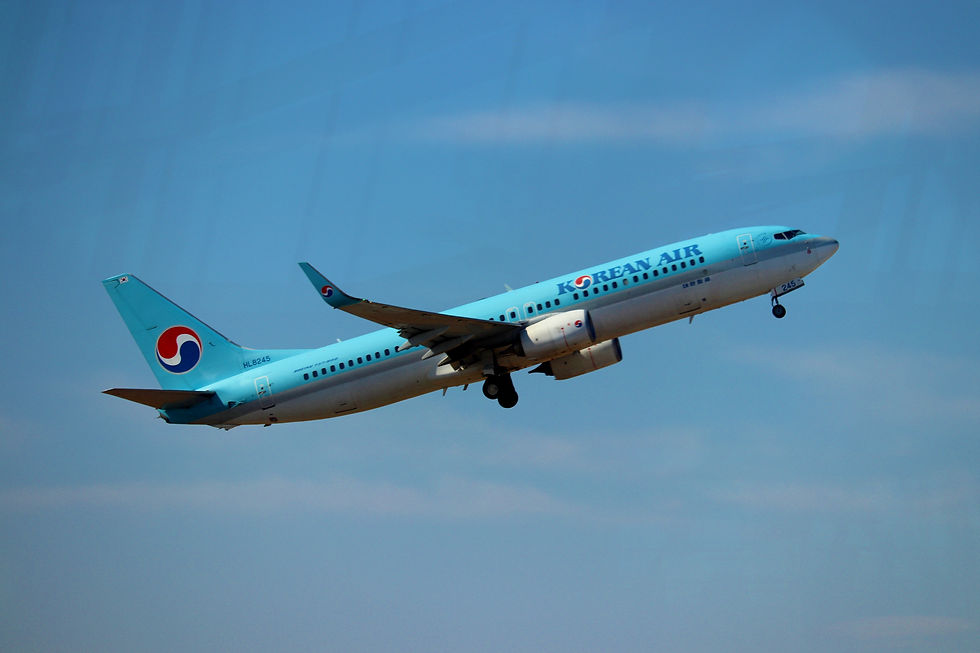
Also in 1997, Korean Air brought in the Airbus A330 into its fleet, it replaced older aircraft such as the McDonnell Douglas DC-10 and early 747's. (Photo: planespotters.net) Korean Air officially introduced the Boeing 737-800 into its fleet in January 2000, intended primarily for domestic and short-haul international routes. The 737-800 brought improved fuel efficiency and passenger comfort compared to its predecessors. Korean Air utilized the aircraft on high-demand domestic routes such as Seoul–Busan and short regional routes to destinations like Tokyo and Shanghai. Over the following years, Korean Air expanded its 737-800 fleet to support the growing demand for domestic travel and regional connectivity. Only a year later in 2001, the first of the larger B737-900 started to arrive at Korean Air.

Korean Air officially introduced the Boeing 737-800 into its fleet in January 2000, intended primarily for domestic and short-haul international routes. (Photo: planespotters.net) A major milestone came on 22 June 2000, when Korean Air became a founding member of the SkyTeam global airline alliance, alongside Air France, Delta Air Lines, and Aeroméxico. This development significantly enhanced Korean Air’s global connectivity, allowing it to offer passengers seamless travel options through codeshare agreements and coordinated schedules.
Fleet modernization was a major focus for Korean Air during the beginning of the new century. The airline gradually retired older Boeing 747-300 and McDonnell Douglas DC-10 aircraft, replacing them with more fuel-efficient and technologically advanced aircraft. Korean Air became an early operator of the Boeing 777-200ER and 777-300ER, and it continued to receive more Airbus A330s for medium-haul international routes.
Korean Air also invested heavily in service quality and safety improvements during this era. Following several high-profile incidents in the late 1990s, the airline launched a comprehensive safety program that included upgraded pilot training, stricter maintenance protocols, and partnerships with international aviation organizations to adopt best practices.
Korean Air officially introduced the Boeing 777-300ER to its fleet on October 23, 2008. The introduction of the 777-300ER allowed Korean Air to expand passenger capacity on long-haul flights while benefiting from improved fuel efficiency and extended range, enabling nonstop services to destinations in North America, Europe, and Asia.

Korean Air officially introduced the Boeing 777-300ER to its fleet on October 23, 2008, painting this example in the colours of the SkyTeam Alliance which was founded in June 2000. (Photo: planespotters.net) The airline undertook significant branding and customer experience initiatives. Korean Air revamped its lounges, particularly at Incheon International Airport, offering premium amenities and expanding services for business and first-class passengers.
By 2010, Korean Air had firmly positioned itself as one of the largest airlines in the Asia-Pacific region in terms of passenger traffic, international destinations, and fleet size. The airline continued to expand into secondary markets, launching new routes to cities in Central Asia, the Middle East, and South America, including Buenos Aires and São Paulo, although these long-haul routes were sometimes seasonal or limited in frequency due to demand constraints.
Korean Air was one of the proud Asian airlines to introduce the Airbus A380-800 into its fleet on October 24, 2011, marking a significant milestone in the airline’s history as the first South Korean carrier to operate the world’s largest passenger aircraft. The inaugural A380 flight was deployed on the Seoul Incheon to Los Angeles route, showcasing the aircraft’s long-haul capabilities and enhanced passenger comfort. Korean Air configured its A380s with a three-class layout: First Class, Prestige Class (business), and Economy Class, providing a total of 495 seats.
The introduction of the A380-800 allowed Korean Air to strengthen its long-haul network, particularly to high-demand international destinations.

The mighty Airbus A380-800 joined Korean Air on October 24, 2011. The inaugural A380 flight was deployed on the Seoul Incheon to Los Angeles route. (Photo: planespotters.net) Between 2012 and 2016, Korean Air focused on sustaining profitable growth while navigating rising competition from low-cost carriers in the region and addressing operational challenges such as labor strikes and fluctuating fuel costs. The airline remained committed to fleet renewal, placing orders for the Boeing 787-9 Dreamliner and additional Boeing 777-300ERs to replace aging 747-400 aircraft and expand long-haul capacity. These acquisitions were part of a broader strategy to reduce fuel consumption, improve reliability, and offer enhanced passenger comfort. Korean Air also modernized its cargo fleet with Boeing 747-8 Freighters, cementing its position as a leader in air freight.
In 2016, Korean Air officially expanded its long-haul passenger fleet with the introduction of the Boeing 747-8 Intercontinental (747-8i). The first aircraft was delivered on March 31, 2016. This next-generation jumbo jet brought enhanced passenger comfort, including a redesigned cabin, quieter engines, and increased range, allowing Korean Air to operate longer non-stop flights efficiently.

Korean Air is the only airline in the world, together with Lufthansa, which has operated every variant of the Jumbo Aircraft. In 2016, Korean Air officially expanded its long-haul passenger fleet with the introduction of the Boeing 747-800 Intercontinental (747-8i). The first aircraft was delivered on March 31, 2016. (Photo: planespotters.net) From 2017, Korean Air continued to solidify its position as South Korea’s flagship carrier. In 2017, Korean Air introduced several new aircraft such as the Boeing 787-9 Dreamliner and the Airbus A220-200 into its fleet. The airline also made substantial orders for the Airbus A380 and the Boeing 747-8i, reinforcing its commitment to maintaining a versatile fleet capable of serving both high-capacity and ultra-long-haul markets. That same year, the airline expanded its network with new destinations, including additional routes to Europe such as Prague and Istanbul, as well as North American destinations including Seattle and Toronto.

In 2017, Korean Air introduced several new aircraft such as the Boeing 787-9 Dreamliner into its fleet. (Photo: planespotters.net) 
For short domestic flights, Korean Air also received the smaller Airbus A220-300 in December 2017. In 2018 and 2019, Korean Air further accelerated its fleet renewal program. The airline began phasing out older Boeing 747-400s and smaller, less efficient aircraft in favor of next-generation models like the Boeing 787-9 and the Airbus A330-300.
However, the COVID-19 pandemic in 2020 posed unprecedented challenges for the airline, severely reducing international passenger traffic. Korean Air responded by adjusting its operations, temporarily suspending several long-haul routes, and increasing cargo flights to meet surging demand for freight, including medical supplies and e-commerce shipments. The airline’s cargo division became a critical revenue source during this period, demonstrating the flexibility of its operations. By 2021 and 2022, Korean Air gradually resumed passenger services, prioritizing routes to major hubs in North America, Europe, and Asia, while continuing to operate essential cargo services.

The COVID-19 pandemic in 2020 posed unprecedented challenges for the airline, but Korean Air responded by adjusting its operations, temporarily suspending several long-haul routes, and increasing cargo flights to meet surging demand for freight, specially with the economics of the B747-8F at the time. (Photo: planespotters.net) Korean Air introduced the Airbus A321neo into its fleet in October 2022, marking a significant step in modernizing its narrow-body operations. Korean Air planned to gradually expand the A321neo fleet over the next few years, strengthening connectivity to key regional destinations in Asia and improving operational flexibility for high-demand routes. Another short to medium aircraft addition to the fleet in November 2022, was the Boeing 737-8Max. The arrival of the 737-8 MAX represented Korean Air’s first direct introduction of Boeing’s latest-generation narrowbody aircraft, designed to replace older Boeing 737-800s over time. Configured in a two-class layout. The airline placed orders for 18 units plus 20 options along a huge order for the larger B737-10Max for 62 units.

The Airbus A321neo joined Korean Air in October 2022, marking a significant step in modernizing its narrow-body operations. (Photo: planespotters.net) 
Another fleet addition in November 2022, was the Boeing 737-8Max. (Photo: planespotters.net) From 2023 onward, Korean Air has continued fleet modernization with the introduction of additional Boeing 787-9s and Airbus A321neo aircraft, reflecting a focus on operational efficiency and passenger comfort. The airline has also explored expanding its route network to emerging destinations in Central Asia and Africa.
Another important event came in December 2024, when Korean Air officially introduced the Boeing 787-10 Dreamliner into its fleet. Korean Air positioned the 787-10 primarily for high-demand international routes. Following the initial delivery, additional 787-10s were scheduled to join the fleet throughout 2025 and 2026, supporting Korean Air’s network expansion in Asia, North America, and Europe.
The same month, in December 2024, Korean Air expanded its long-haul fleet with the introduction of the Airbus A350-900, a state-of-the-art widebody aircraft known for its fuel efficiency and passenger comfort. The new A350-900 features advanced aerodynamics, a quieter cabin, and improved seating layouts.

In December 2024, Korean Air introduced the Boeing 787-10 Dreamliner, supporting the airline's network expansion in Asia, North America, and Europe. (Photo: planespotters.net) 
The same month, in December 2024, Korean Air also was proud to receive its first Airbus A350-900, a state-of-the-art widebody aircraft known for its fuel efficiency and passenger comfort. (Photo: planespotters.net) Korean Air unveiled a major update to its corporate identity in early 2025, marking the airline’s first comprehensive branding refresh in over four decades since the introduction of the iconic “Taegeuk” logo in 1984. The new branding, officially presented on March 11, 2025, retained the airline’s signature sky-blue colour but introduced a more modern and simplified Taegeuk symbol. The first aircraft to be repainted in the new livery was a Boeing 787-10, registered HL8515, which was revealed to the public on the same day as the branding launch.

Korean Air unveiled a new branding on March 11, 2025, which retained the airline’s signature sky-blue colour but introduced a more modern and simplified Taegeuk symbol. The first aircraft to be repainted in the new livery was a Boeing 787-10. (Photo: planespotters.net) Looking to the future, Korean Air plans significant expansion of both its fleet and network. The airline has placed orders for the latest Airbus A350-900 and Boeing 777X aircraft, which will allow it to serve ultra-long-haul destinations more efficiently while offering cutting-edge passenger amenities. Korean Air is actively exploring new intercontinental routes, with particular interest in North and South America, Europe, and Africa, as well as underserved Asian markets.
These plans coincide with a broader vision of reinforcing its role in the global airline industry, not only as a leading carrier in Asia but also as a competitive long-haul airline capable of connecting key business and leisure destinations worldwide. With this strategy, Korean Air aims to balance operational efficiency, passenger comfort, and environmental responsibility, ensuring sustainable growth well into the next decade.
Airline Factual Information
As of 2025, Korean Air is one of the 11 airlines ranked 5-star airline by Skytrax, and the top 20 airlines in the world in terms of passengers carried and is also one of the top-ranked international cargo airlines. The airline's international passenger division and related subsidiary cargo division together serve 126 cities in 44 countries. As well, it flies to 13 domestic destinations.
Korean Air, has developed an extensive global operation centred on its primary hub at Seoul Incheon International Airport (ICN) since the airport’s opening on 29 March 2001. The move from its former main base at Seoul Gimpo International Airport (GMP) to the newly built Incheon hub marked a significant milestone, allowing the airline to expand long-haul operations and establish one of Asia’s most important connecting hubs between North America, Europe, and Asia. However, it still operates from Gimpo, mostly to domestic and regional destinations.
Korean Air, currently flies to the following destinations*:
Region 🗺️
Destinations 🌍🌎🌏
Domestic
• South Korea: Busan, Cheongju, Daegu, Gwangju, Gunsan, Jeju, Jinju, Pohang, Seoul (Gimpo & Incheon), Ulsan, Wonju, Yeosu
East Asia
• China: Beijing, Changsha, Dalian, Guangzhou, Hangzhou, Hefei, Huangshan, Jinan, Kunming, Mudanjiang, Nanjing, Qingdao, Shanghai, Shenyang, Shenzhen, Tianjin, Wuhan, Xi'an, Xiamen, Yanji • Hong Kong: Hong Kong • Japan: Aomori, Fukuoka, Kagoshima, Komatsu, Nagoya, Niigata, Okayama, Osaka, Sapporo, Tokyo (Haneda & Narita) • Mongolia: Ulaanbaatar • Taiwan: Taichung, Taipei
Southeast Asia
• Cambodia: Phnom Penh • Indonesia: Denpasar, Jakarta • Malaysia: Kuala Lumpur • Myanmar: Yangon • Philippines: Cebu, Manila • Singapore: Singapore • Thailand: Bangkok, Chiang Mai, Phuket • Vietnam: Da Nang, Hanoi, Ho Chi Minh City, Nha Trang, Phu Quoc
South Asia
• India: Delhi
Europe
• Austria: Vienna • Czechia: Prague • France: Paris • Germany: Frankfurt • Hungary: Budapest • Italy: Milan, Rome • Netherlands: Amsterdam • Spain: Barcelona, Madrid • Switzerland: Zurich • Turkey: Istanbul • United Kingdom: London (LHR)
North America
• Canada: Toronto, Vancouver • United States: Atlanta, Boston, Chicago, Dallas/Fort Worth, Honolulu, Las Vegas, Los Angeles, New York City, San Francisco, Seattle, Washington, D.C.
Oceania
• Australia: Brisbane, Sydney • New Zealand: Auckland • Guam: Guam
*Updated April 2026
As of early 2026, Korean Air operates a total fleet of approximately 160 aircraft, spanning both passenger and dedicated cargo operations. From the smaller Airbus A220 to the mighty double decker Airbus A380-800 and Boeing B747-8i, which provide international connectivity from Seoul to many destinations globally.
The airline’s fleet currently is on going with new deliveries from both Airbus and Boeing, in particular Airbus A350 and A321neo and Boeing 737-8Max, B787-10 and future B777-900 to be announced in the coming years.
The Korean Air fleet consists of the following aircraft*:
Aircraft Type
In Service
On Order
Configuration (F, C, P, Y)
Airbus A220-300
10
—
(Y) 2-3
Boeing 737-800
2
—
(C) 2-2 / (Y) 3-3
Boeing 737-900
9
—
(C) 2-2 / (Y) 3-3
Boeing 737-900ER
6
—
(C) 2-2 / (Y) 3-3
Boeing 737 MAX 8
6
11
(C) 2-2 / (Y) 3-3
Boeing 737 MAX 10
—
62
TBA
Airbus A321neo
19
37
(C) 2-2 / (Y) 3-3
Airbus A330-300
17
—
(C) 2-2-2 / (Y) 2-4-2
Boeing 787-9
14
6
(C) 2-2-2 / (Y) 3-3-3
Boeing 787-10
12
53
(C) 1-2-1 / (Y) 3-3-3
Airbus A350-900
3
3
(C) 1-2-1 / (Y) 3-3-3
Airbus A350-1000
—
20
TBA
Boeing 777-300
4
—
(C) 2-3-2 / (Y) 3-3-3
Boeing 777-300ER
25
—
(F) 1-2-1 / (C) 2-2-2 / (Y) 3-3-3
Boeing 777-9
—
40
TBA
Boeing 747-8I
4
—
(F) 1-1 / (C) 2-2-2 / (Y) 3-4-3
Airbus A380-800
6
—
(F) 1-2-1 / (C) 2-2-2 / (Y) 3-4-3
*Updated April 2026
(Configuration: F = First Class, C = Business Class, P = Premium Economy , Y = Economy)


Reviews and comments ⭐
What Stands Out 😀👍 | Needs Improvement 🫤👎 |
✅ Industry-Leading Legroom: Passengers consistently praise the "best-in-class" 33–34 inch seat pitch in Economy, providing much more comfort than competitors. | 👎 Aging Cabin Hardware: Many reviews highlight a "retro" or "outdated" feel on older Boeing 777 and 737 aircraft, citing small, low-resolution screens and bulky seats. |
✅ Exceptional Staff Hospitality: Flight attendants are frequently described as "impeccably polite," "warm," and "attentive," often going above and beyond for families with children. | 👎 Inconsistent Business Class: Travelers often complain about "equipment swaps" where a modern Prestige Suite is replaced by an older 2-3-2 layout without prior notice. |
✅ High-Quality Dining: The airline's signature bibimbap and diverse meal options are widely regarded as some of the most flavorful and healthy "airplane food" available. | 👎 Inflexible Ticketing Policies: Negative reviews often cite high cancellation fees and a "rigid" customer service approach when handling flight changes or refunds. |
✅ Operational Efficiency: Frequent flyers appreciate the "systematic" and "orderly" boarding procedures and the airline's strong record for on-time departures. | 👎 Limited English Entertainment: Some Western passengers find the in-flight movie selection somewhat limited compared to other global carriers, with fewer English-language options. |
✅ New Fleet Modernization: The introduction of the Airbus A321neo and Boeing 787-10 is highly praised for bringing cutting-edge technology and full lie-flat seats to regional routes. | 👎 Strict Weight Enforcement: Recent reviews mention a "zero tolerance" policy for carry-on weight, including the strict practice of weighing personal items and cabin bags together. |
*Reviews are collected from independent sites and compelled by the most representative reviews and comments. Planet Airlines Ltd remains impartial to any airlines.