

Airline Chronological History
Jeju Air is a low cost airline based in Jeju City, Jeju, Island, South Korea. Jeju Air was established in January 2005 and began operations on June 2, 2006. It is owned by the Aekyung Group and the Jeju Provincial Government.It started operations with the Bombardier Dash 8 Q400.

At the beginning Jeju Air operated several Dash Q400 turboprop aircraft. (Photo:airliners.net) On July 11, 2008, Jeju Air made its first international flight from Jeju to Hiroshima. It offered at first regular domestic scheduled services between Jeju Island and the South Korean mainland. Its then opened up its main hubs at Gimpo International Airport and Incheon Seoul, where it started flying to a number of regular international destinations.

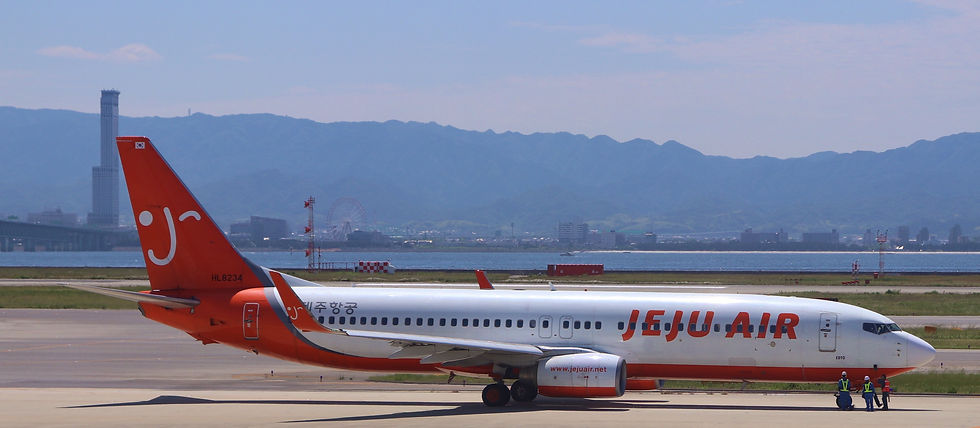
From 2008 Jeju Air received the Boeing 737-800 which is started international operations from Gimpo International Airport and Incheon in Seoul. (Photo: airhistory.net/) From 2008 onward, Jeju Air entered a decisive phase of consolidation and expansion that would transform it from a small regional low-cost carrier into South Korea’s largest LCC. The airline phased out its earlier turboprop operations in 2010 and standardized around the Boeing 737-800, configured in a high-density single-class layout to maximize seat capacity and reduce unit costs. Between 2009 and 2010, Jeju Air began expanding beyond South Korea’s domestic market into neighbouring countries. The airline launched new international services to Japan, including routes to Osaka and Nagoya, as well as to China and Southeast Asia.
By 2011 and 2012, Jeju Air had established itself as a key player in the Korean low-cost market, competing with other emerging LCCs such as Jin Air, Air Busan, and Eastar Jet. The airline continued to expand its international footprint, adding routes to destinations such as Bangkok, Manila, and Hong Kong.
By 2013 and 2014, the airline had expanded its fleet into the mid-teens, all composed of Boeing 737-800 aircraft, each typically configured with around 180 to 189 seats in a single-class layout. During these years, Jeju Air continued to launch new routes to Japan, China, Taiwan, and Southeast Asia, including popular destinations such as Taipei, Cebu, and Da Nang.
The years 2016 and 2017 were characterized by continued expansion and network diversification. Fleet growth continued, with the airline surpassing 20 Boeing 737-800 aircraft, all configured in high-density economy class.
By 2018, Jeju Air had firmly established itself as the largest low-cost carrier in South Korea in terms of passenger numbers and revenue. Its fleet had grown to more than 30 Boeing 737-800 aircraft. The airline operated an extensive network of domestic and international routes, serving destinations across Japan, China, Taiwan, Southeast Asia, and parts of Russia. New routes launched around this time included services to cities such as Vladivostok and additional Southeast Asian destinations.

By 2018, Jeju Air had firmly established itself as the largest low-cost carrier in South Korea with a fleet of more than 30 Boeing 737-800 aircraft. (Photo: Planepictures.net) Jeju Air announced in November 2018, it is ordering 40 737 MAX 8 airplanes with options for 10 additional jets. The deal, is the largest order ever placed by a Korean low cost carrier and reflects rising demand for air travel in South Korea. The new aircraft would be delivered between 2022 and 2026.
Throughout 2019, Jeju Air maintained strong operational momentum. Passenger traffic continued to rise, supported by sustained demand on Korea–Japan and Korea–Southeast Asia routes. However, this trajectory was abruptly disrupted in 2020 by the global outbreak of COVID-19. International travel restrictions severely impacted Jeju Air’s core business model, which depended heavily on cross-border leisure travel. The airline responded by shifting focus toward domestic routes, particularly the highly trafficked Seoul–Jeju corridor, one of the busiest domestic air routes in the world. During the pandemic period from 2020 to 2022, Jeju Air, like many LCCs, encountered regulatory scrutiny and financial strain; reports indicate that it accumulated fines and operational suspensions related to aviation law breaches during these years.
The airline continued to operate a standardized Boeing 737 fleet, maintaining cost efficiency even as international expansion remained limited.
A major strategic turning point occurred as global travel restrictions eased in 2022 and 2023. Jeju Air resumed suspended international routes and launched new services, particularly to Japan and Southeast Asia.
Parallel to route expansion, fleet modernization became a central component of Jeju Air’s post-pandemic strategy. The airline had placed significant orders for the Boeing 737-8 (737 MAX) aircraft with the first arriving in November 2023, with plans to introduce dozens of these more fuel-efficient jets to replace older B737-800 models.

The airline had placed significant orders for the Boeing 737-8 (737 MAX) aircraft with the first arriving in November 2023. (Photo: Planetspotters.net) By 2024, Jeju Air had already begun receiving and operating these newer aircraft, integrating them into its fleet as part of a broader effort to reduce operating costs, improve fuel efficiency, and support longer-range routes. The gradual replacement and supplementation of older 737-800 aircraft with newer models reflected a long-term strategy to maintain competitiveness in an increasingly cost-sensitive market.
Despite these advances, late 2024 brought a major crisis. In December 2024, a Jeju Air Boeing 737-800 operating a flight from Bangkok to Muan, skidded along a runway, crashed into a wall and burst into flames, officials said. A total of 181 people were onboard and only two flight attendants survived.
This event became one of the most serious aviation disasters in South Korean history and triggered intense regulatory scrutiny of the airline’s safety practices, maintenance procedures, and operational standards. The incident also highlighted the airline’s high aircraft utilization rates, which, while economically efficient, raised concerns about potential impacts on maintenance and crew fatigue.
Following the accident, Jeju Air faced reputational challenges and increased oversight from aviation authorities. However, the airline continued its operations while implementing safety reviews and improvements. At the same time, it maintained its growth trajectory, with continued delivery of new aircraft and expansion of routes planned into 2025 and beyond, including additional Japanese destinations such as Hakodate and further Southeast Asian services.
By the mid-2020s, Jeju Air had evolved into a mature low-cost carrier with a diversified network, a modernizing fleet, and a strategic focus on both efficiency and expansion.
Airline Factual Information
Jeju Air is operating not only the most busiest route, Gimpo-Jeju, in South Korea but also has more than 51 major routes in Asia, such as Japan, China, Taiwan, Philippines, Vietnam, Thailand and Guam, including other domestic routes. The airline has it's main bases in Jeju Island, Incheon International (ICN) and Gimpo (GMP) the last two in Seoul.
Jeju Air flies to the following destinations*:
Region 🗺️
Destinations 🌍🌎🌏
East Asia
• South Korea: Seoul (Incheon, Gimpo), Jeju, Busan, Cheongju, Daegu, Gwangju, Muan • Japan: Tokyo, Osaka, Fukuoka, Nagoya, Sapporo, Okinawa, Matsuyama, Shizuoka, Oita, Hiroshima, Kagoshima • China: Beijing, Shanghai, Qingdao, Weihai, Harbin, Yanji, Jiamusi, Shijiazhuang, Zhangjiajie, Guilin • Hong Kong: Hong Kong • Macau: Macau • Taiwan: Taipei, Kaohsiung • Mongolia: Ulaanbaatar
Southeast Asia
• Vietnam: Hanoi, Ho Chi Minh City, Da Nang, Nha Trang, Phu Quoc • Thailand: Bangkok, Chiang Mai • Philippines: Manila, Cebu, Clark, Bohol • Malaysia: Kota Kinabalu • Singapore: Singapore • Laos: Vientiane • Indonesia: Batam, Denpasar (Bali)
Oceania
• Northern Mariana Islands: Saipan • Guam: Guam
Updated April 2026
The fleet of Jeju Air has expanded tremendously in the last years, having its own planes purchased by the airline rather than leasing them from other companies. The airline relies exclusively on one plane type for all it’s operations. Boeing has supplied it’s aircraft ever since it first started operations. The Boeing 737 is one of the most reliable equipment on the current market. At present the airline has 43 Boeing airliners in operation with new ones arriving in the coming years, such as the B737-8Max.
The fleet* consists of the following aircraft:
Aircraft Type
In Service
On Order
Configuration (F, C, P, Y)
Boeing 737-800
35
—
(Y) 3-3
Boeing 737 MAX 8
8
32
(Y) 3-3
Updated April 2026
(Configuration: C = Business Class, P = Premium Economy , Y = Economy)


Reviews and comments ⭐
What Stands Out 😀👍 | Needs Improvement 🫤👎 |
✅ Excellent Value for Money: Passengers frequently highlight that the airline offers incredibly competitive and cheap fares for short-haul travel. | 👎 Strict and Pricey Baggage Polices: Many travellers report rigid enforcement of hand luggage weight limits and unexpectedly high fees at the counter for slightly overweight bags. |
✅ Friendly Cabin Crew: Onboard staff are widely praised for being polite, welcoming, and smiling despite the high-paced low-cost environment. | 👎 Uncomfortable for Long Hauls: Reviews point out that the slimline seats and tight 29-inch legroom make 4+ hour international flights feel physically draining. |
✅ Punctuality on Domestic Routes: Flights between mainland South Korea and Jeju Island are often commended for being strictly on time or even landing early. | 👎 No Free Amenities: Passengers are often disappointed to find that everything from seat selection to a simple bottle of water must be paid for on board. |
✅ Modern Fleet: Passengers enjoy flying on the clean, newer aircraft models, specifically noting the fresh cabins of the newly introduced Boeing 737 MAX 8. | 👎 Challenging App and Website: Foreign travellers heavily critique the digital booking systems, stating that pages often fail to load or revert to Korean during checkout. |
✅ Efficient Self-Service Check-In: Travelers at major hubs like Seoul Incheon and Tokyo Narita note that the electronic kiosks make getting boarding passes a breeze. | 👎 Poor English Customer Support: When flights are delayed or cancelled, non-Korean speakers frequently note a total lack of helpful communication or support from the airline. |
*Reviews are collected from independent sites and compelled by the most representative reviews and comments. Planet Airlines Ltd remains impartial to any airlines.