

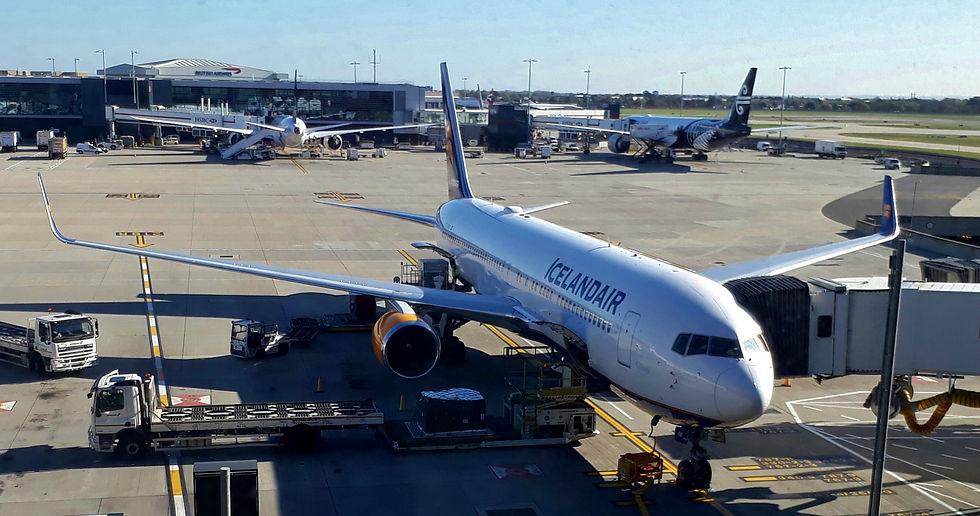
Airline Chronological History
Icelandair traces its roots back to 1937, when Flugfélag Akureyrar was founded in Akureyri on the north coast of Iceland. Flight operations started in 1938 with a single floatplane Waco YKS-7. In 1939 the airline was grounded when this aircraft was destroyed in a capsizing accident. The company moved to Reykjavík, where it acquired another Waco aircraft and was re-launched in 1940 as Flugfélag Íslands, then for international purposes, the name Iceland Airways was adopted.

The airline was first known as Flugfélag Akureyrar. Flights started with a single floatplane Waco YKS-7 in 1938. (Photo: flugsafn.is) The fleet was expanded with a Beechcraft Model 18 in 1942; and with two de Havilland Dragon Rapides and a Consolidated PBY Catalinain 1944. On 11 July 1945, this aircraft operated the first commercial flight over the Atlantic Ocean for the airline, from Reykjavík to Largs in Scotland. Regular flights to Prestwick in Scotland and Copenhagen in Denmark started using Consolidated B-24 Liberator aircraft leased from Scottish Airlines in 1946. In the same year, comfort and performance of domestic flights in Iceland improved with the introduction of the Douglas DC-3, the oldest one being still flight-worthy as of 2011.

The DC-3 was introduced in 1946 with Flugfélag Íslands on flights to the UK and Denmark. (Photo: flugsafn.is) International services stayed part of the business model of Flugfélag, though to a far lesser extent compared to Loftleiðir. In 1948, the Douglas C-54 Skymaster was introduced on those routes, and in 1957 two new Vickers 759 Viscounts were acquired, the first turboprop airliners to be operated by an Icelandic airline. In the 1950s, Flugfélag began to use the 'Icelandair' branding for its international flights.

In 1957 two new Vickers 759 Viscounts were operated. (Photo: archive.is) In 1967, Flugfélag introduced the first jet airliner in Iceland, a Boeing 727-100, with it a new livery was used as well. Another 727 was acquired in 1971, and the aircraft type was operated until the 1990's

The first jet aircraft for Icelandair, a Boeing 727-100, operated in 1967 (Photo: .flickr.com) Another company called Loftleiðir had been formed in 1944 concentrated on Icelandic domestic air services for the first few years but then opened scheduled international operations in 1947. By 1952, the Icelandic authorities were very worried that fierce competition between both Icelandic airlines would ruin both companies, and attempted to force a merger between them. This did not happen at the time, but instead the authorities split up the domestic routes between the two airlines. As a result, Loftleiðir ceased domestic flights in Iceland entirely, concentrating instead on international flights. During those years, Loftleiðir was often referred to, even by the company's own staff, as "the Hippie Airline" or even "the Hippie Express". Loftleiðir was not famous for speed or punctuality, but flying with the company became a sort of rite of passage for young "hippies" from America travelling to Europe.
During the 1970s energy crisis, the economic situation for both Flugfélag and Loftleiðir worsened. The government of Iceland initiated a new attempt to merge the two airlines, which happened in 1973. A holding company called Flugleiðir was created, which combined the two companies and began to streamline staff and operations. At the time of the merger, two thirds of the passenger traffic of the airline were international transatlantic crossings, and Flugfélag's fleet of Douglas DC-3s and Boeing 727s was enlarged by the Douglas DC-8s of Loftleiðir. In 1979, Flugfélag bought all of Loftleiðir's assets, and the airline was renamed Icelandair.

In 1979 the fleet grew with the Douglas DC-8s of Loftleiðir which was merged and renamed as Icelandair (Photo: Airliners.net) The aircraft fleet of Icelandair remained mainly unchanged until the Boeing 757-200 became the new backbone for transatlantic flights during the 1990s. The domestic Fokker F27s were replaced by Fokker 50s and Boeing 737s deployed on European routes. In 1997 the domestic operations of Icelandair, part of which had previously been operated under the 'Flugfélag Nordurlands' branding, were combined with small airline Nordurflug to form the Air Iceland Connect subsidiary, allowing mainline Icelandair to fully concentrate on international flights since then. On 20 November 1999, a new aircraft livery was introduced, as part of an image campaign designed to retire Icelandair's "backpacker" label in favor of an emphasis on business travel.

The Boeing 757-200 was introduced in the 1990's and replace the DC-8, B727 and other older aircraft (Photo: al-airliners.be) The Flugleiðir holding was reorganized as Icelandair Group (for aviation business) and FL Group between 2002 and 2005, with Icelandair becoming the largest and most important of eleven subsidiaries. Like most Icelandic companies, Icelandair was hit quite hard by the 2008 financial crisis in the country, but was well on the road to recovery when another crisis of a very different kind hit in 2010. The air traffic restrictions following the 2010 eruptions of Eyjafjallajökull resulted in large parts of the European airspace being closed down. In the aftermath of the eruption, the government of Iceland launched the successful "Inspired by Iceland" campaign to regain confidence in travelling to Iceland for tourists and business people.

In 2010, the Eyjafjallajökull Volcano erupted in Iceland, causing chaos to airlines, however Icelandair was still able to operate via smaller airports. It was a great logistical operation one that has made the Icelandic airline stronger since then. (Photo: tripsavvy.com) After having launched scheduled flights to Washington D.C. in 2011, Denver was announced as a new U.S. destination for 2012, followed by Anchorage in 2013, bringing the total number of cities served in the country up to eight, along with Boston, Minneapolis, New York City, Orlando and Seattle. Also in 2012, Icelandair resumed domestic services, with regular flights linking Akureyri to its Keflavík hub through subsidiary company Air Iceland. New destinations in 2014 were Edmonton and Vancouver in Canada and Geneva.
On 9 December 2014, Icelandair revealed a northern lights themed Boeing 757-200 named Hekla Aurora. The aircraft was officially launched in February 2015 as part of the company’s #MyStopover campaign. As part of Icelandair’s transatlantic fleet, the Hekla Aurora flies to all of the airline’s 40 destinations and has a three-day schedule available for passengers and observers via it’s website.

In February 2015, Icelandair flew it's special livery plane, a northern lights themed Boeing 757-200 named Hekla Aurora. (Photo: community.infinite-flight.com) On 5 February 2015, Birmingham became Icelandair’s 5th gateway in the UK. In May 2015 Icelandair launched scheduled flights to and from Portland, Oregon in the US. Further expansion of Icelandair’s global network was announced on 12 May 2015 with new, year-round services from Chicago. On 17 August 2015 Icelandair announced the augmentation of its global flight network with a new service between Keflavik and Aberdeen, the company’s second Scottish destination. The new service, operated by Air Iceland Connect (a subsidiary of Icelandair Group). It also commenced scheduled flights to Paris Orly Airport beginning on 29 March 2016 and to Montreal in 2016.
In Sep 2017 Icelandair started services to Philadelphia and Tampa, US starting in Sep 2017. In May 2017, Icelandair unveiled a glacier-themed special livery on Boeing 757-200 named Vatnajökull, the name of Europe's largest glacier. The special livery was created in order to commemorate Icelandair's 80th anniversary. It also introduced the Boeing B767 into the fleet to cope with the expansion of the airline as it awaited for new deliveries placed with Boeing for B737 Max.

The Boeing 767 was introduced in 2017 to help increase capacity on key routes to Europe and America. (Photo: Planepictures.net) In 2018, it saw the airline receive a new aircraft type, when in April 2018 it took delivery of the first new generation Boeing 737-800 Max to open up new routes and replace older types such as the B757 and B767. Also in 2018, Icelandair started flying to Kansas and Cleveland, US and commenced weekly flights to and from Dallas Ft. Worth.

The Boeing B737-800 Max was the newest aircraft for Icelandair and opened up new markets for the airline from April 2018. (Photo: Planepictures.net) However, 2018 was also marked by significant financial pressure. Increased competition, rising fuel costs, and operational challenges contributed to declining profitability. A major turning point came with the collapse of Iceland’s low-cost competitor WOW air in early 2019, which, while removing a rival, also created short-term instability in Iceland’s aviation market.
In 2019, Icelandair sought to stabilize its operations and capitalize on the vacuum left by WOW air. The airline adjusted its route network, reinstating or increasing capacity on several routes that had been heavily contested. However, the global grounding of the 737 MAX in March 2019 forced the airline to suspend use of the new aircraft shortly after their introduction. Despite these setbacks, Icelandair continued to maintain a wide network, linking dozens of European cities with North American destinations such as New York, Boston, Chicago, and Seattle.
The year 2020 brought unprecedented challenges as the COVID-19 pandemic caused a near-total collapse in global air travel. Icelandair drastically reduced its flight operations, shifting temporarily toward cargo and repatriation flights. The airline grounded much of its fleet and implemented major cost-cutting measures, including layoffs and renegotiation of labor agreements.
In 2021, Icelandair began a gradual recovery as travel restrictions eased. The airline rebuilt its network step by step, reintroducing transatlantic services and restoring key European routes. Demand was initially driven by leisure travel, particularly from North America to Iceland, which had positioned itself as a relatively accessible destination during parts of the pandemic. Icelandair resumed flights to major U.S. gateways such as New York (JFK), Boston, and Chicago, while also restoring connections to European capitals. While the Boeing 737 MAX returned to service globally, Icelandair reassessed its long-term fleet needs, recognizing that the aging Boeing 757 fleet would eventually require replacement.
On 9 March 2021, Icelandair Group announced that Air Iceland Connect is to merge its sales operations with Icelandair by uniting domestic and international brands from 16 March 2021 and continuing the current flight operations under the Icelandair brand. The company Air Iceland Connect continues to operate domestic flights under its own Air Operator's Certificate but using the Icelandair brand.
A significant development came in 2021 when Icelandair announced an agreement to acquire Boeing 737 MAX aircraft in both the -8 and -9 variants, reinforcing its commitment to narrowbody efficiency for medium-haul routes.
In 2022, Icelandair announced the selection of the Airbus A321LR, and later the A321XLR, marking the first time in decades that the airline committed to Airbus aircraft. This decision represented a major shift away from an all-Boeing fleet and was driven by the need for fuel efficiency, range flexibility, and lower operating costs. The A321LR and XLR were intended to replace both the Boeing 757 and, on some routes, complement or substitute the Boeing 767. Deliveries were scheduled for the mid 2020's.
In January 2022 Icelandair updated the airline livery, with new colours drawn from Icelandic nature, including the beloved northern lights. This is the first time the whole livery design has been changed since 2006, and is part of a complete refresh of the Icelandair brand. TF-ICE, a Boeing 737 MAX 8 was the first of Icelandair’s fleet to be painted in the new livery.

In January 2022 Icelandair refreshed its branding with a Boeing 737 MAX 8, the first of Icelandair’s fleet to be painted in the new livery. (Photo: jetphotos.com) By 2023, Icelandair had largely restored its pre-pandemic network and, in some areas, surpassed it. The airline continued to grow in North America, adding destinations such as Detroit and Pittsburgh, reflecting a strategy of targeting underserved secondary cities that could support transatlantic service via Reykjavik. The airline also continued to operate Boeing 767 aircraft on higher-demand routes, maintaining a mixed fleet to balance capacity and flexibility.
In 2024 and into 2025, Icelandair’s transformation has continued with the gradual introduction of Airbus narrowbody long-range aircraft, marking a new era in its operational model. The A321LR began to take over routes previously served by the Boeing 757. Throughout this period, Icelandair has also strengthened its partnerships and codeshare agreements, enhancing connectivity beyond its own network.

In December 2024, Icelandair received its first A321LR for long haul operations, beginning the retirement of older models like the Boeing 757 and B767. (Photo: jetphotos.com) By the present day, Icelandair stands as a restructured and modernizing airline, with a diversified fleet that includes Boeing 737 MAX aircraft, remaining Boeing 757 and 767 units, and the newly introduced Airbus A321LR, with A321XLR deliveries on the horizon. Its network continues to emphasize transatlantic connectivity via Iceland, with a balance between major hubs and secondary cities in both Europe and North America.
Airline Factual Information
The airline bases all it's operations in its only hub at Keflavik International Airport, in the south of Iceland. It acts as an important stop over city to many connecting passengers who choose to take the airline via Reykjavik as to transit either to Europe or North America. Icelandair connects about 25 gateways in Europe with about 20 gateways in North America.
Additionally, Icelandair operates domestic services, with regular flights linking Akureyri, Egilsstaðir and Ísafjörður to its Keflavík hub through subsidiary company Air Iceland.
Icelandair flies to the following destinations*:
Here is the corrected table with the domestic row placed at the top:
Region 🗺️
Destinations 🌍🌎🌏
Domestic (Iceland)
• Iceland: Akureyri, Egilsstaðir, Ísafjörður
Europe
• Belgium: Brussels • Denmark: Copenhagen • Finland: Helsinki • France: Nice, Paris • Germany: Berlin, Frankfurt, Hamburg, Munich • Ireland: Dublin • Italy: Milan, Rome • Netherlands: Amsterdam • Norway: Bergen, Oslo • Portugal: Lisbon • Spain: Alicante, Barcelona, Madrid • Sweden: Gothenburg, Stockholm • Switzerland: Zurich • United Kingdom: Glasgow, London
North America
• Canada: Toronto, Vancouver • United States: Baltimore, Boston, Chicago, Denver, Detroit, Minneapolis, New York, Orlando, Portland, Raleigh/Durham, Seattle, Washington, Pittsburgh
Updated March 2026
The fleet of Icelandair is currently under a transitioning period with new Airbus A321LR and XLR aircraft arriving in the coming years, bringing many enhancements to the passenger experience and to the company itself as more fuel efficient planes arrive.
Most of the aircraft in Icelandair's fleet are named after Icelandic volcanoes as a curiosity. The Fleet is based upon the Boeing 737-8Max and the Airbus A321LR, with older models due to be retired in the coming years to harmonise the fleet around these two types.
The airline uses most aircraft on all routes depending on demand and season, since most of it's aircraft can cover every route offered.
The fleet* consists of the following aircraft including those operated under its domestic subsidiary Air Iceland Connect:
Aircraft Type
In Service
On Order
Configuration (F, C, P, Y)
De Havilland Canada DHC-8-200
3
0
(Y) 2-2
De Havilland Canada DHC-8-400
3
0
(Y) 2-2
Boeing 737 MAX 8
17
0
(C) 2-2 / (Y) 3-3
Boeing 737 MAX 9
4
0
(C) 2-2 / (Y) 3-3
Airbus A321LR
4
5
(C) 2-2 / (Y) 3-3
Airbus A321XLR
0
13
(C) 2-2 / (Y) 3-3
Boeing 757-200
8
0
(C) 2-2 / (Y) 3-3
Boeing 767-300ER
2
0
(C) 2-2-2 / (Y) 2-3-2
Updated March 2026
(Configuration: F = First Class, C = Business Class, P = Premium Economy , Y = Economy)


Reviews and comments ⭐
What Stands Out 😀👍 | Needs Improvement 🫤👎 |
✅ Punctuality: Many passengers report that flights frequently arrive on time or even ahead of schedule, making it a reliable choice for tight schedules. | 👎 "Nickeling and Diming": Reviews frequently complain that even on long-haul flights, meals, snacks, and headphones must be purchased separately. |
✅ Generous Stopover Program: The option to stay in Iceland for up to seven days at no extra airfare cost remains a highly praised and unique highlight. | 👎 Rigid Baggage Enforcement: Passengers often report being charged high fees at the gate for carry-on bags that are only slightly over the strict 10kg limit. |
✅ Friendly Cabin Crew: Staff are often described as professional, polite, and helpful, maintaining a calm atmosphere even during busy flights. | 👎 Outdated Business Class: Frequent flyers note that "Saga Class" lacks lie-flat seats, making it feel more like a premium economy product than true Business Class. |
✅ Efficient Transit Hub: The layout of Keflavík Airport (KEF) is generally viewed as easy to navigate for quick connections between Europe and North America. | 👎 Cramped Economy Seating: Several reviews highlight limited legroom and narrow seats on older aircraft, which can be uncomfortable for flights over 5 hours. |
✅ Modern In-Flight Entertainment: Passengers enjoy the seat-back screens which offer a decent selection of movies and unique Icelandic documentaries. | 👎 Subpar Customer Support: Feedback often mentions long wait times and difficulty reaching human agents when dealing with vouchers or refund claims. |
✅ Cleanliness and Maintenance: The aircraft cabins are consistently rated as clean, well-maintained, and featuring pleasant "Northern Lights" mood lighting. | 👎 Inconsistent Amenities: Passengers are often surprised to find that pillows and blankets are not always provided for free in the economy cabin. |
*Reviews are collected from independent sites and compelled by the most representative reviews and comments. Planet Airlines Ltd remains impartial to any airlines.