


Airline Chronological History
Finnair is one of the world’s oldest operating airlines. Since it was founded, the company has grown from a small airline to a strong and respected member of the international airline industry. Finnair, then known as Aero, was founded in 1 November 1923. In 1924, Aero received its first aircraft, a German-made Junkers F 13. The Junkers was a seaplane, it used skis in winter and floats in summer. At the time, there were no commercial airfields on land in Finland. Aero operated its flights from downtown Helsinki. The aircraft’s maiden commercial flight was to carry mail from Helsinki to Tallinn. Later it was used on flights between Helsinki and Stockholm in cooperation with the Swedish airline ABA.During its first year, Aero carried a total of 269 passengers. The seaplane service ended in December 1936 following the construction of the first aerodromes in Finland.

In 1924, Finnair received its first aircraft, the German made Junkers 13, operating with floats. (Photo: yle.fi) Air raids on Helsinki and other Finnish cities made World War II a difficult period for the airline. Half the fleet was requisitioned by the Finnish Air Force and it was estimated that, during the Winter War in 1939 and 1940, half of the airline's passengers from other Finnish cities were children being evacuated to Sweden. In 1941 during the Continuation war in 1941–44, Aero once again was put under military control. During that time, the airline temporarily operated from Pori.
After the war in 1946, the Finnish State acquired a majority holding in Aero, which had previously been a private company, re-established services to Europe in November 1947, initially using the Douglas DC-3.

After WWII, Finnair was re-established by the state. It operated DC3's to Europe. (Photo:yle.fi) Aero started using the name Finnish Air Lines on its fleet livery in 1947.That same year, Aero also recruited its first stewardesses. At first they only flew on the domestic Helsinki–Kemi and Helsinki–Kuopio routes. In 1949 Aero became a member of IATA (the International Air Transport Association) and received its airline code AY, the same that Finnair is still using today. Aero started using the name Finnair in its marketing already in 1953, even though the official name change did not happen until 1968. The Convair 440 twin-engined pressurised airliner was acquired from January 1953 and these faster aircraft were operated on the company's longer routes as far as London. Aero opened a new route to Moscow in 1956, being the first Western airline to do so after the war.

The Convair 440 was purchased from 1953, making more comfortable flights for passengers. (Photo:airliners.net) In 1961, Finnair joined the jet age by adding Caravelles to its fleet. These were later exchanged with the manufacturer for Super Caravelles. .The first jet routes were Helsinki–Copenhagen–Cologne–Frankfurt and Helsinki–Stockholm. Later the Caravelles were also used on flights to Hamburg, Amsterdam, London, Paris, Zurich and Malmö. In 1962, Finnair acquired a 27% controlling interest in a private Finnish airline, KarAir. Finnair Oy became the company's official name on 25 June 1968.
In 1968 Finnair revealed its new logo and made the name change official. Finnair flights from Helsinki to New York via Copenhagen and Amsterdam began 15 May 1969, when it took possession of its first U.S. made jet, a Douglas DC-8.

Finnair added the first jets to it's fleet in 1961 in the form of Caravelles. (Photo:airliners.net) 
In 1969, Finnair took delivery of the DC-8, it's first U.S. made jet. It used it on services to New York. (Photo:airliners.net) Finnair received its first wide-body aircraft in 1975, two DC-10-30 planes. The first of these arrived on 4 February 1975, and entered service on 14 February 1975, flying between Helsinki and New York, and later between Helsinki and Las Palmas. Finnair started its expansion to Asia with direct flights to Bangkok in 1976.
In 1979, Finnair established a subsidiary Finnaviation for domestic operations, with a 60% stake. In 1981, Finnair opened routes to Seattle and Los Angeles. Finnair became the first operator to fly non-stop from Western Europe to Japan operating Helsinki-Tokyo flights with a McDonnell Douglas DC-10-30ER in 1983. With extra fuel tanks on the plane, the route took passengers over the North Pole.
A Finnair aircraft flew in the livery of Santa Claus in 1984. The company would become “The Official Carrier of Santa Claus” four years later. The blue Finnair look was first introduced in one of the aircraft in 1985 and gradually extended to cover the whole fleet. Finnair was the first airline to acquire satellite telephones for its DC-10 aircraft in 1986. The same year Finnair received its first Airbus aircraft, the A300.
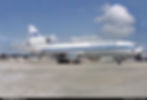
In 1975, the airline added it's first wide-bodied jet, the DC-10-30. (Photo:jetphotos.com) 
The first Airbus A300 arrived from 1986. (Photo:airplane-pictures.net) Finnair launched a Helsinki-Beijing route in 1988, making Finnair the first Western European carrier to fly non-stop between Europe and China. In 1989, Finnair became the launch customer for the McDonnell Douglas MD-11, the first of which was delivered on 7 December 1990. The first revenue service with the MD-11 took place on 20 December 1990, operating a flight from Helsinki to Tenerife in the Canary Islands.

In 1990 the airline took delivery of the MD-11, Finnair was the launch customer for the type. (Photo:jetphotos.com) In 1997, the subsidiaries Kar-Air and Finnaviation became wholly owned by Finnair, and were integrated into the mainline operations. On 25 September 1997, the company's official name was changed to Finnair Oyj. In 1999, Finnair joined the Oneworld airline alliance. In 2001, Finnair reused the name "Aero" when establishing Aero Airlines, a subsidiary airline based in Tallinn, Estonia.
Finnair received its first narrow-body aircraft manufactured by Airbus, the Airbus A321, on 28 January 1999. The first Airbus A319 aircraft was then delivered on 20 September 1999.

By 1999 Finnair started to receive more modern aircraft like the A321. (Photo:abpic.co.uk) The decreasing demand for air travel after the terrorist attacks in New York on 11 September 2001 forced Finnair to take measures to cut costs and adjust capacity. More capacity was transferred to the Helsinki–Bangkok route due to the better market climate for Asian traffic. Flights to Hong Kong began in 2002 and the flight frequency to Bangkok was increased to a daily service. The Shanghai route was opened in 2003.
In 2003, Finnair acquired ownership of the Swedish low-cost airline, FlyNordic, which operated mainly within Scandinavia. In 2007, Finnair sold all its shares in FlyNordic to Norwegian Air Shuttle. In 2005, Finnair placed an order for nine Airbus A350 aircraft, it was the first airline to order the new type.
In 2006 it received it’s first wide bodied Airbus A340-300 which it used for its long haul routes. On 8 March 2007, it increased it's order for Airbus A350 aircraft, up by two more Airbus A350 XWB, with delivery to start in 2015. Finnair received its first A330-300s on 27 March 2009. The airline had eight Airbus A330-300 aircraft in the fleet which were replaced by the larger A350.

The A340-300 joined in 2006 to fly the carriers long haul routes to Asia and North America. (Photo:airplane-pictures.net) 
The A330 also joined in 2009, being more fuel efficient and modern, it improved economics for the airline. (Photo:jetphotos.com) The company revealed a new livery in December 2010. Major changes include a restyled and larger lettering on the body, repainting of the engines in white, and a reversal of the colour scheme for the tail fin favouring a white background with a blue stylized logo. Finnair suffered from many labour disputes in this period, resulting from cost-cutting measures prompted by competition from budget airlines. As a result, on 1 December 2011, Finnair transferred its baggage and apron services to Swissport International as per a five-year agreement signed on 7 November 2011.
During 2011, a new direct route was opened to Singapore. Finnair was the first carrier to open a non-stop route between Europe and Chongqing in 2012. Direct flights to Hanoi and Xi’an began in 2013.
In November 2014, Finnair agreed to acquire the Flybe 60% share of the joint venture it created back in 2011, known as Flybe Nordic. The airline then operated under Finnair's flight code since 1 May 2015, the day Flybe Nordic was rebranded as Nordic Regional Airlines and continued operating with ATR-72 and Embraer 170 with Embraer E190 being incorporated as well from 2015.

Operated as Nordic Regional Airlines, Finnair took over in 2015 from "Flybe Nordic" and inherited the ATR-72. (Photo: planespotters.net) 
From 2015, Finnair also added the E190 for its regional subsidiary, Nordic Regional. (Photo: planespotters.net) Finnair’s first Airbus A350-900 entered service on 9 October 2015, operating its inaugural commercial flight from Helsinki to Shanghai (Helsinki–Vantaa to Shanghai Pudong).
This made Finnair the first European airline to operate the A350 XWB, and the route choice reflected its strategy of focusing on Asia-Europe connections via Helsinki.

In 2015, Finnair took delivery of its first A350-900. (Photo:airbus.com) Beginning in 2016, Finnair was in the middle of an ambitious expansion phase built around the strategic idea of using its geographic location in northern Europe as a hub connecting Europe with Asia. Helsinki’s position allows relatively short flight times on polar routes, and Finnair invested heavily in wide-body aircraft, especially the Airbus A350-900, which it had begun receiving in 2015 as the first European airline to operate the type. These aircraft were designed to replace older Airbus A340s. Around this time Finnair also continued to operate Airbus A330-300 aircraft on intercontinental routes while maintaining an Airbus narrow-body fleet for European services.
In 2016 Finnair opened direct routes to Guangzhou in China and Fukuoka in Japan, reinforcing its strategy of expanding connections to secondary Asian cities rather than relying solely on major capitals.
The airline’s expansion continued in 2017 with new long-haul flights to San Francisco and short-haul services to Reykjavik. Finnair officially retired the Airbus A340-300 in January 2017, making the final commercial flight operating from Tokyo Narita (NRT) to Helsinki (HEL) on the 31st January 2017.

Finnair’s Airbus A340-300 made its final commercial flight on 31 January 2017, operating from Tokyo Narita (NRT) to Helsinki (HEL). During 2018 Finnair continued to refine its network with new routes such as Lyon and Nanjing. The airline also introduced onboard internet connectivity across its European flights. By 2019 Finnair was still growing strongly and launched new services to Los Angeles, Sapporo in Japan, Porto, and Bologna. It also began operations to Beijing’s new Daxing International Airport alongside its flights to Beijing Capital Airport. This period of expansion ended abruptly in 2020 with the COVID-19 pandemic. Like airlines worldwide, Finnair experienced a catastrophic collapse in passenger demand as borders closed. For much of the year it operated less than ten percent of its normal schedule, furloughed most employees, and refunded hundreds of millions of euros for cancelled flights.
The pandemic continued to affect operations in 2021, forcing Finnair to pursue cost-saving measures and new financing. Nonetheless, it tried to adapt by opening new routes from Stockholm Arlanda to Bangkok, Phuket, Miami, New York and Los Angeles, attempting to diversify beyond its Helsinki hub and capture leisure demand when travel resumed.
By 2022 the airline faced a second major crisis when Russia’s invasion of Ukraine led to the closure of Russian airspace. Because Finnair’s Asia strategy depended heavily on flying across Siberia, the loss of these routes dramatically increased flight times and costs to Asian destinations. The airline had to redesign its network and business model, aiming to remain profitable even without overflying Russia. Some aircraft were redeployed to North American or Middle Eastern routes, and Finnair opened new services to Dallas, Seattle, Mumbai and Tokyo Haneda as part of its restructuring.
These geopolitical changes had long-term consequences. Finnair had to cut or suspend numerous destinations and restructure its route network, losing many airports it had served before 2020. The airline also explored wet-leasing aircraft to other carriers to utilize capacity more efficiently and adapt to reduced Asia demand. Despite these challenges, Finnair invested heavily in product improvements in 2022, introducing a new long-haul cabin concept with a redesigned Business Class seat, a new Premium Economy class, and refreshed Economy seating.
In 2023 Finnair celebrated its 100th anniversary, becoming one of the oldest continuously operating airlines in the world. The milestone highlighted its transformation from a small Nordic carrier into a global airline linking Europe with Asia and North America.

To celebrate its 100th anniversary in 2023, Finnair added a special Moomin-themed livery and onboard elements to one of its Airbus A350-900 aircraft. (Photo: planespotters.net) Finnair’s long-haul fleet remains centred on Airbus A350-900 aircraft, with additional aircraft delivered through earlier orders, while Airbus A330-300 aircraft continue serving key routes such as Delhi, Mumbai, New York and Chicago.
Recent plans suggest that Finnair is considering ordering up to thirty new Airbus narrow-body aircraft to replace aging jets as part of its ongoing fleet renewal strategy.
Operational challenges have continued in the mid-2020s. The airline experienced strikes affecting profitability, fluctuations in transatlantic demand. Reports indicate plans for future long-haul expansions, including new connections to Australia via Bangkok using Airbus A350 aircraft, reflecting a diversification strategy beyond traditional Asia-Europe traffic.
In the last years, Finnair’s history has been deeply influenced by its geography and alliances. As a member of the oneworld alliance, it has relied on partnerships with airlines in Europe, North America, and Asia to feed traffic through Helsinki. Recently, its strategy has evolved from Asia-centric growth to a more diversified network including North America, the Middle East, and selected leisure destinations.
Airline Factual Information
Finnair has its main operating base in Helsinki, Vantaa airport, where it flies to all destinations. In the last years the airline has made its hub a major transit point for many travellers connecting to Asia, and on to USA. Finnair flies from its Helsinki hub to over 80 destinations in over 35 countries in Asia, Europe and North America. Finnair also serves six destinations in the United States.
Finnair flies to the following destinations* at the time of publishing:
Region 🗺️
Destinations 🌍🌎🌏
Europe
• Albania: Tirana • Austria: Innsbruck, Salzburg, Vienna • Belgium: Brussels • Bulgaria: Burgas • Croatia: Dubrovnik, Split, Zadar • Cyprus: Larnaca, Paphos • Czech Republic: Prague • Denmark: Billund, Copenhagen • Estonia: Tallinn, Tartu • Finland: Enontekiö, Helsinki, Ivalo, Joensuu, Jyväskylä, Kajaani, Kemi, Kittilä, Kokkola, Kuopio, Kuusamo, Mariehamn, Oulu, Rovaniemi, Tampere, Turku, Vaasa • France: Nice, Paris • Germany: Berlin, Düsseldorf, Frankfurt, Hamburg, Munich, Stuttgart • Greece: Chania, Corfu, Heraklion, Kos, Rhodes, Santorini, Skiathos • Hungary: Budapest • Iceland: Reykjavík • Ireland: Dublin • Italy: Milan, Naples, Rome, Venice, Verona • Latvia: Riga • Lithuania: Vilnius • Netherlands: Amsterdam • Norway: Bergen, Bodø, Oslo, Tromsø, Trondheim • Poland: Gdańsk, Krakow, Warsaw, Wrocław • Portugal: Funchal, Lisbon • Slovenia: Ljubljana • Spain: Alicante, Barcelona, Gran Canaria, Lanzarote, Madrid, Malaga, Palma de Mallorca, Tenerife • Sweden: Gothenburg, Stockholm, Visby • Switzerland: Geneva, Zurich • Turkey: Antalya, Gazipaşa, Istanbul • United Kingdom: Edinburgh, London, Manchester
Asia
• China: Hong Kong, Shanghai • India: Delhi, Mumbai • Japan: Nagoya, Osaka, Tokyo • Singapore: Singapore • South Korea: Seoul • Thailand: Bangkok, Krabi, Phuket • Vietnam: Ho Chi Minh City
Middle East
• Israel: Tel Aviv • Qatar: Doha • United Arab Emirates: Dubai
North America
• United States: Chicago, Dallas, Los Angeles, Miami, New York City, Seattle
Updated March 2026
Finnair operates one the most modern and advanced fleets in Europe. It consists entirely of Airbus aircraft with the addition of Embraer and ATR turboprop aircraft for domestic and regional routes, flown by Norra. (Nordic Regional Airlines).
Below is the fleet* flown by Finnair:
Aircraft Type
In Service
On Order
Configuration (F, C, P, Y)
ATR 72-500
12
0
(Y) 2-2
Embraer E190
12
0
(C) 2-2 / (Y) 2-2
Airbus A319-100
5
0
(C) 3-3 / (Y) 3-3
Airbus A320-200
10
0
(C) 3-3 / (Y) 3-3
Airbus A321-200
15
0
(C) 3-3 / (Y) 3-3
Airbus A330-300
8
0
(C) 1-2-1 / (P) 2-3-2 / (Y) 2-4-2
Airbus A350-900
17
2
(C) 1-2-1 / (P) 2-4-2 / (Y) 3-3-3
Updated March 2026
(Configuration: F = First Class, C = Business Class, P = Premium Economy , Y = Economy)


Reviews and comments ⭐
What Stands Out 😀👍 | Needs Improvement 🫤👎 |
✅ Helsinki Hub Efficiency: Passengers consistently praise the smooth, modern, and "stylish" transit experience at Helsinki Airport, noting it as one of the best connection points in Europe. | 👎 Customer Support Accessibility: Many reviews highlight extreme difficulty in reaching a human representative, with long wait times on phone lines and a "robotic" or non-functional chat service. |
✅ Innovative Business Class: The "AirLounge" non-reclining shell seat on long-haul flights is highly rated for its privacy, space, and unique comfort, especially for side-sleepers. | 👎 Refund and Compensation Delays: A significant number of passengers report "administrative stonewalling" when seeking legally mandated compensation for cancellations or lost baggage. |
✅ Nordic Hospitality: Onboard cabin crew are frequently described as polite, professional, and helpful, maintaining a calm and pleasant atmosphere during the flight. | 👎 Cramped Economy Seating: Travelers on long-haul routes often complain about a tight seat pitch and "thin" padding in Economy, making the 8–10 hour journeys feel uncomfortable. |
✅ Signature Refreshments: The complimentary blueberry juice remains a cult favorite among passengers, often cited as a small but meaningful touch of Finnish culture. | 👎 Inconsistent Food Quality: While Business Class meals receive praise, Economy Class food is frequently described as small, repetitive, or lacking in flavor and variety. |
✅ Punctuality and Reliability: Despite external challenges, the airline is often commended for its high on-time performance and "clean, tidy" aircraft interiors. | 👎 Hidden Fees & Strict Rules: Recent reviews express frustration over aggressive gate-checking fees for carry-ons and confusing rules regarding beverage limits during meals. |
*Reviews are collected from independent sites and compelled by the most representative reviews and comments. Planet Airlines Ltd remains impartial to any airlines.